5 December 2017

Two lessons learnt after three months of volunteering at three hospices…

Long time back, I had read a book “Top Five Regrets of a Dying Man” by an Australian hospice nurse – Bronnie Ware who had distilled her 51 years of being around people who were waiting to die in 5 simple truths on what we regret about when we look back at life. Sometime around then, working at a hospice became an entry in my my bucket list after reading that book.

First, I reasoned that it would help me set perspective for the years I have left. But more importantly, I thought there was a second part of that book Bronnie meant to write some day – what the postitive reflections are that people have once they realize that their days are numbered.

Getting the opportuinity to work at three hospices for the last three months (started with seven patients, lost four of them and added six more), I am starting to get some glimpse of those reflections. Specifically, I have come to two realizations…

Lesson 1: People take great pride in their children

Without exception, every patient – at least the ones that can hold a rational discussion – is very proud of their children. Even the most quiet ones can become animated if you just ask them “What do your kids do?”

You probably remember the gentleman who kept his daughter’s phone number in his hat. You may also remember the blind gentleman who was very proud of how much his kids do for him. I even have a patient who has a picture of herself with her three kids on her shelf – but I am not allowed to talk about the daughters (who as I understand are fighting unsuccessfully drug addiction and swindled their mom of a lot of money). Try talking to her about her son though and she will hold court for at least half an hour before she will come up for breath.

The general sense I get is that in your last days, you realize that your kids are one of the very few things that are absolutely your own creation. Nobody else could have create exactly they way they are. And in any which way you have influenced them – your effects in this world is going to outlive you by about 30 years or even more.

Lesson 2: Everybody has a story. And they want to tell it.

Once a patient starts opening up, almost always it is about their past life. It is like they just want somebody to listen to their reflections. Most are very proud of what their life has been.

The other day, as I was walking from the parking lot of one of the hospices to the building itself, I saw an old lady walking along with her walking stick enjoying the sun. No sooner than had I greeted her and asked her how she was doing (I did not know her at all), she stood there for thirty five minutes and gave me a synopsis of her life story. With a great sense of humor too!

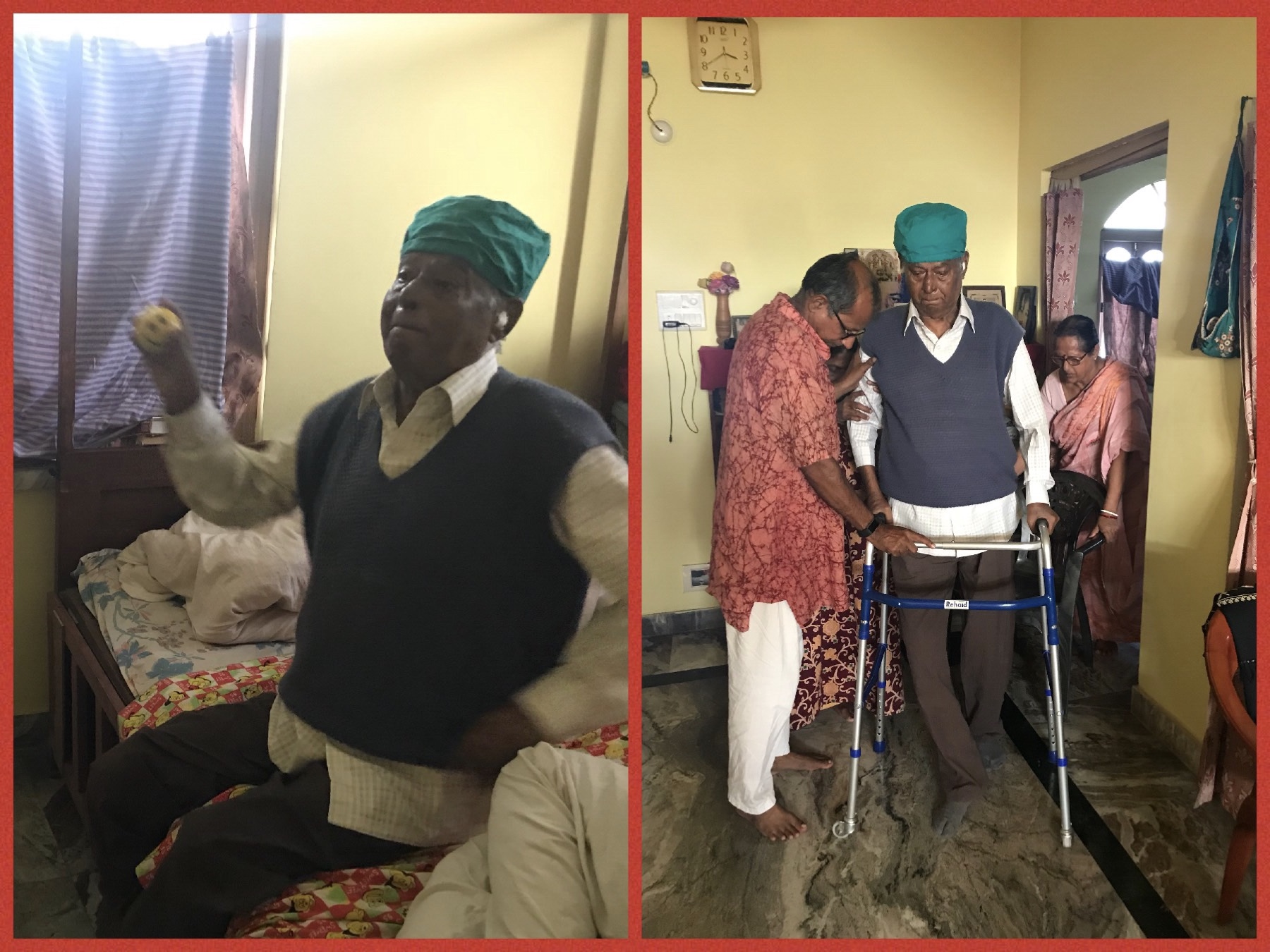
One of those patients who is no more (in fact, he passed away when I had gone to India to tend to my dad), used to wait for me to come the next time to tell me one more of his chapter of life. Same with the blind gentleman.

Now, realize that some of those stories were not very consisten. For sure, they were biased. But the accuracy of the story is not my point.

My point is, I think before they die, they want their story to be heard. They want to leave their story behind. They are proud of the unique achievements they have had and most look back with some satisfaction. But there are no avenues for them to let the world know of their story. And perhaps, they realize that with them, their story will die too. Not too many of them are going to write down autobiographies.

Giving them an avenue to narrate their story the way they saw their life is an interesting “service” I have stumbled upon. One thing is for sure – each and every one of them has a story. And they are in a hurry to get it out… if you have the time to listen.

Those are the two lessons for now.

Would love to exchange notes with any of you who might have had similar or contrarian experiences.

I will certainly keep you posted as I learn more from my association with hospice patients.

23 November 2017

Of turkeys and such…

“Good Morning! How are you?”
I quickly recovered from the unexpected greetings from a stranger, stopped in my tracks and wished back – “I am good. A very happy Thanksgiving to you. How are you?”
“I am waiting for my son to come and pick me up”, he said grinning from ear to ear.
“That is so nice. Have a great family time”.

By this time, I had figured out what was going on. I went to the lady sitting in the next sofa with a walker near by. “Good morning. And a very happy Thanksgiving. How are you doing this morning?”
“Happy Thanksgiving to you too. I am waiting for my son in law”.

This morning after my coffee and all that, I told Sharmila that I would go make the rounds in all the three hospices and try to be back before the girls wake up. I was worried that some of the patients may not be able to see their families on Thanksgiving day (some have family well outside the state). I was going to wish them a very happy Thanksgiving and if I found that somebody was not going to get the gift of family presence for one reason or the other, I was going to sit with them and perhaps spend some time with them. I am no family to any one of them but caring and companionship might count in their books, I figured.

As I entered the first hospice, I sensed right away that something was different. There were a lot of the patients sitting in the atrium. Most of them were not in their shabby clothes. And everybody seemed to be wearing a smile. I was briskly walking past them to meet my own friends there when I was stopped by one of those sitting in the atrium. And that is how the conversation above came about.

I went from table to table, sofa to sofa and pretty much wished everybody who was sitting there and it was more or less the same story. Everybody was waiting for their son or daughter or son in law to pick them up and take them to their homes so they could have some family time together on this Thanksgiving day. And without exception, all of them were going to come back the same night.

Finally, I went and visited two of my friends who live in the assisted area side. One – who is my assigned patient was waiting for her daughter to come and wheel her out. The other – the blind old gentleman who is not an assigned patient of mine was super excited. He had a tie on and a tucked in shirt, a vest and the whole nine yards.

“You must be very excited that you are going to see your family today?”, I asked.
Big mistake.
“Well. Raj, I am not going to exactly see them”, he said gesturing some air quotes with his fingers. Gosh, that could have been really really awkward for me had he not started laughing – “You know what I mean. I have gone blind. I can’t see. But yes, I am very excited.” Well, everybody was in good mood!!

The scene inside the memory care unit (this is where all the folks with Alzheimer’s Parkinson’s, brain cancer, deep dementia etc stay in secured premises) was a little different. The same wishes from me about Thanksgiving had most of them staring at me. I realized that none of them had any idea that it was Thanksgiving today or had any memory of what Thanksgiving was all about.

Lowell was still relentlessly pacing up and down the corridors in very small steps talking to himself incessantly. Jenny asked me to look at the red birds flying behind my head as a response to my Thanksgiving wishes. Leanne was constantly shaking even as she sat there staring at the Macy’s Thanksgiving parade put up on the TV in the common area.

Then a gentleman walked in and went straight past me and sat next to a lady sleeping on a sofa on the other end of the room. She was a patient there – and I had seen her before but I had never talked to her. After about five minutes, I noticed that the lady was still sleeping and the gentleman was still sitting next to her watching the TV. He looked neither like a patient nor a staff member.

Curiosity got the better of me and I went over to him and introduced myself. Found out that he was that lady’s son. She is not in a situation to go home. She cannot have Thanksgiving dinner with them. She would not even recognize any of the family members. He is the only surviving child of hers. He had come to give her company for a few hours before he went back and joined the rest of the family for their family get together.

My story about learning the true spirit of Thanksgiving and family ties today will not be complete if I did not tell you about another set of people in the hospices – the staff there. Me having my big mouth obviously had to go around wishing them and asking them about their plans. I was really amazed and somewhat taken aback to realize how much adjustments they and their families made to their personal lives to accommodate the far less fortunate patients. As an example, the CNA had completed her Thanksgiving dinner the previous night with her family so she could spend the time taking care of the patients thru the day. Not one of them seemed to betray any frustration for having to work today. If anything, they seemed to be trying harder to make the patients feel happy!

Driving back home – very hungry (I did have one patient who had no family coming – so I landed up spending an hour talking to him and that made me very hungry in the morning) and somewhat overwhelmed, I tried sorting out in my mind the great strength of family ties that binds us together. The wheel bound stranger waiting with a grin on his face for his son to take him home for a few hours, the son who came just to sit by his mom who has lost her ability to understand what a family means, the staff who has chosen to balance the family at home and those that they are family to – their patients…

It is a great thing that at least once a year, we all step back from our daily lives to acknowledge our immediate and often our larger families. In this hustle bustle of modern life, it reminds us about what should be truly important to us.

Happy Thanksgiving y’all!!

17 November 2017

Cafe con Laura

Last time I saw Laura was when my family went over to her place to have dinner with her family. That was six years back – almost to the day. Nov 20, 2011 to be precise.

And it was in Santiago, Chile!!!

Today, I met her in my neck of the woods – Milton, Georgia – over a couple of cups of coffee. We had a great time together – talking about our old workplace, colleagues from our prior lives and our own parents!!

Found out an interesting coincidence. When I drove to meet my colleague from Mumbai days at a Starbucks in Appleton, Wisconsin in September, apparently, I was within spitting distance of where Laura’s parents live!! Oh! How I wish I knew that then!!!

16 November 2017

What if your eyesight was taken away from you?

I was somewhat flummoxed about what to do next. I had just concluded visiting one of my patients in the hospice. I had gone to see a new patient that I had been just assigned but he was deep in slumber. At that hospice, those were the only two patients I had. I was wavering between whether to go back home or visit another hospice center half an hour away when I noticed a blind person shuffling along with his walking stick in the corridor. Two things stood out. First, he was reasonably well dressed – and when I say well dressed in a hospice, I mean his shirt was tucked in and his hair was combed. However, he also did not seem to know where he was going.

I stepped up, cleared my throat and asked – “Are you trying to go somewhere, Sir?”
“Yes, I am trying to get to my room”, he replied.
“You live here?” I will admit, I did not think of him as a patient.
“Yes. But they have changed my room. And I am all confused now”.

“Okay. Maybe I can be helpful. What is your room number?”
“I think it is 5…7… something”.
I knew that the hospice had no such room number. The highest was 540. So, tactfully, I asked “By the way, my name is Raj. What is your name?”
“Louis Armstrong” (name changed to maintain privacy).
“Hang on here”.

Then I walked up and down a couple of corridors and found his name tag outside room 531.
“Okay. Your room number is 531. I can help you get there”.
“Thank you. Who are you?”
“Oh! I am just a volunteer. I spend time with patients”.
“So you are a doctor or a nurse?”
“No. I just spend time with patients”
“Doing what?”
“Mostly talking to them. Listening to them. Giving them company. Taking them for a walk. You know all that stuff I am allowed to do without a medical degree”.

By now, we had entered his room, All this time he used his walking stick to feel his way thru and I would just tell him which way to turn.
“So, you just talk to people?”. HE seemed almost incredulous.
“Yeah! Something like that”
“So, you will talk to me?”

Well, that presented an interesting conundrum. He is not a patient of mine. In fact, he is not even a patient of the company I volunteer for. But what the heck? I did not have anything better to do.

“Sure. Tell me your story. Who are you? Why are you?”

And the afternoon started rolling from there….

Louis was a NASA engineer. He worked on the first stage of the rocket that eventually put the first man on the moon. He also worked on the first stage of the rocket that put the shuttle into space.

And he was a World War II veteran. Who served in Burma where he was shot down from the sky.

Suddenly, he asked “Where are you from?”
“India”
“Which part of India”
“Calcutta”
“I have been to Calcutta”
“You have?”
“Yes. Do you know what is a third class compartment?”
(I had a vague memory that trains in India had three classes of compartments when I was growing up – usually it is only two now)
“I can’t remember”
“Well, there is no glass in the windows for the third class”
Laughing, I asked “How do you know?”
“Well, we were sent from Bombay to Calcutta by third class compartment in a train to proceed to Burma”
“Ah!”

Louis has gone blind slowly over the last thirty years.
“Glaucoma?”, I asked
“Exactly. Are you sure you are not a doctor”
“Trust me. I am very sure. Tell me how was the transition. Are you used to it now?”

“Raj, unless you are born blind, you never get used to getting blind. You really do not know how much you give up till your eyesight is actually taken away from you. I know it is fall season now. I know how the trees and leaves used to look like but I cannot see it now.”

“Do you think it is more difficult to be born blind or go blind”?
After a few seconds of thought, he said “I do not think I can compare. I do not know what being born blind is like. But I also think it is much harder if you are given something and then it is taken away from you than never been given at all. You do not know any different when you never had it to begin with”.

Believe it or not, by then, it was almost an hour and a half that we had been talking. And when I say, talking – I mean he did all the talking. I was mostly listening.

Finally, I let him know that I needed to go.

“Raj – you said Raj is your name right….?”
“It is Rajib. But I go often by Raj”
“Right Raj. I know you do not do this for a living. So you may not come back. And even if you did and went past me, I won’t realize it. But if you find time, I would like to spend more time with you.”
“Sure thing. I have so much more to know about the rest of the life”
“No. Next time, I want to hear about who you are”
“You do?”
“I do.”

Well then, I have to come back, don’t I?

Post Script: Two days later, I went back to the same hospice. After finishing with my own patients, I went looking for him. He was not in his room. I went around all the corridors and finally found him in the common area totally immersed listening to the piano being played by a gentleman who was doing a rather good job at it, I thought. Another volunteer, like me, no doubt.

I thought a lot and decided not to bother him. Felt guilty that I did not let him know that I was around. But did not want to distract him from something he was obviously enjoying either. Will go see him tomorrow.