Goodhart goes to bed!
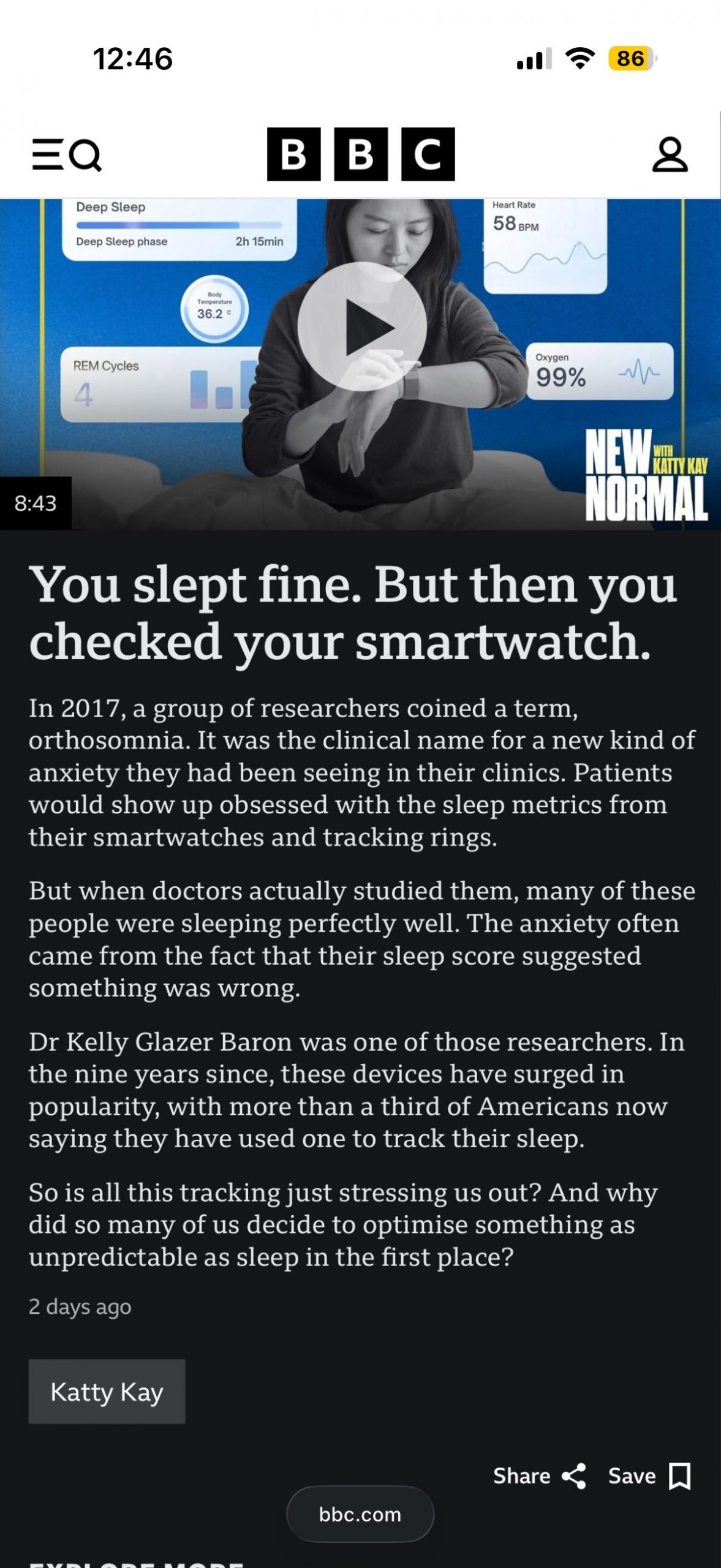
This BBC article caught my eye. It resonated strongly with my own experience. I would be curious to hear from others who use sleep monitors – has your experience been similar?
I used to monitor my sleep religiously. Every night, I wore my Apple Watch to bed. Every morning, I would wake up and check not just how long I had slept, but also the quality of that sleep. I did this for years.
Fun fact: if you sleep for a really long time—something like twelve hours—you can actually earn a “blue ring” on the Apple Watch. Ask me how I know…
It got to the point where I would wake up, squint at my watch before I had even put my glasses on, and immediately decide whether I felt energetic or tired based on whatever number it showed me.
Then one day, I began to suspect that Goodhart’s Law might be at work: when a measure becomes a target, it ceases to be a good measure.
So, about a year ago, I decided to run a little experiment.
(I can be incredibly nerdy when the mood strikes.)
I kept a pen and paper on my bedside table. Every morning, before looking at my watch, I forced myself to ask one simple question: Do I actually feel well rested? I wrote down my answer.
After a month, I downloaded all the sleep data and compared it with my notes.
There was absolutely no pattern.
In fact, on several days, the two completely contradicted each other.
I kept the experiment going for another two months, just to make sure.
The one conclusion I came away with was this: my feeling of being well rested (or exhausted) was being governed almost entirely by what the sleep monitor told me—not the other way around.
That was the day I stopped wearing sleep monitors altogether.
I also retired my running watches.
For the last nine months or so, I have been trying to do something much less scientific and much more difficult: listen to my own body.
I’m still learning. But I don’t miss the gadgets at all.
Instead, I now have a wrist bracelet made from bike chain. I tell myself I look way cooler now 🙂