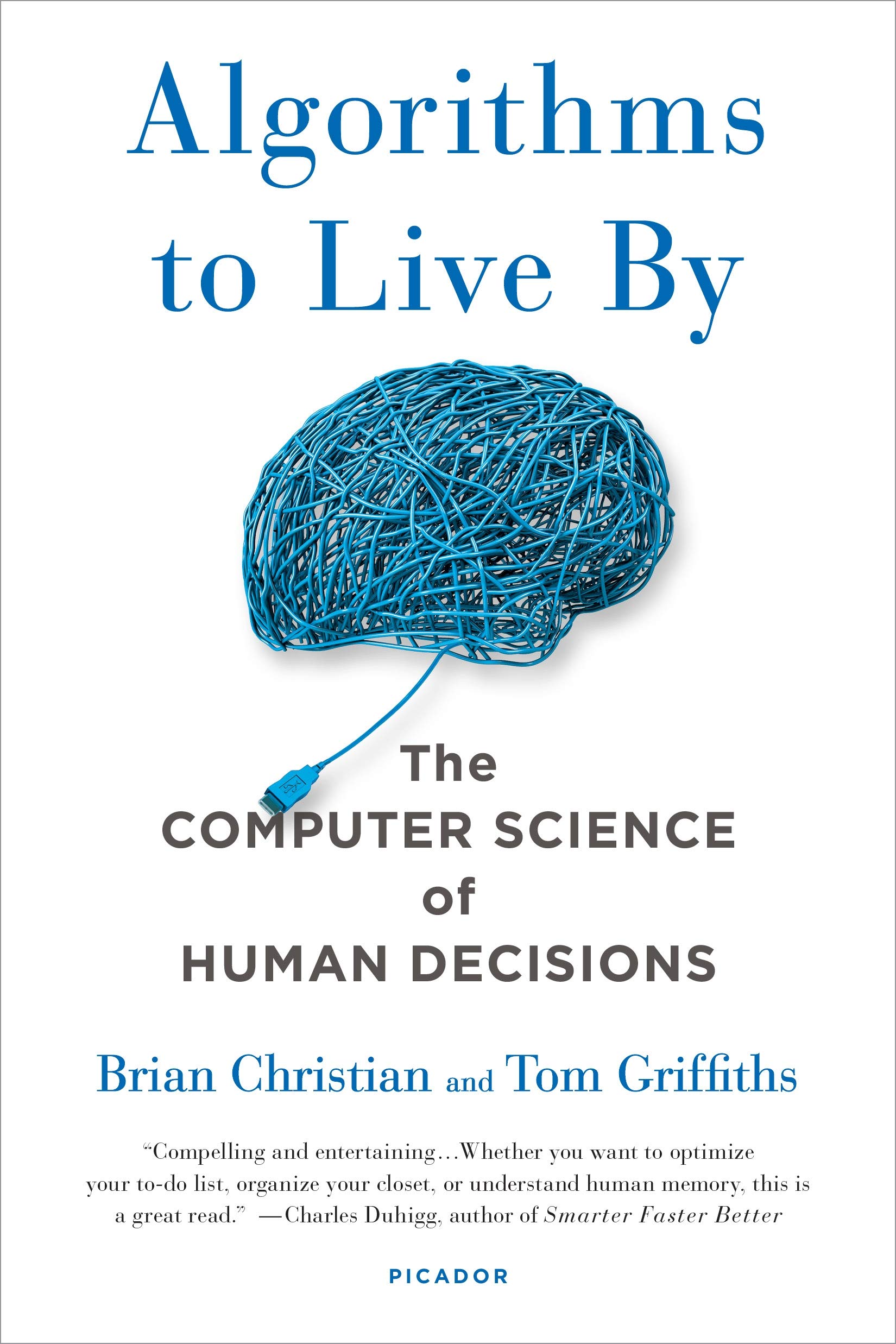
Book Review: Algorithms to Live By – by Brian Christian and Tom Griffiths
This book was recommended to me by my friend Sunjay Talele. The title seemed vaguely familiar when he mentioned it, but I had never actually read it. I fixed that oversight this month.
If you have even a passing familiarity with common computer algorithms or statistical and mathematical concepts, you will love this book. It brilliantly demonstrates how many real-life problems have already been solved by algorithms that computer scientists and mathematicians have been studying for decades. The fascinating part is that we often end up applying these algorithms instinctively, without even realizing it. The flip side is equally intriguing: if we actually understood the algorithms, we might make even better life decisions.
Take the “optimal stopping” problem. Imagine you’re evaluating candidates and trying to make the best possible choice. The catch is that once you pass on someone, they’re gone forever. But you also don’t want to stop too early and miss an even better option. This applies to dating, hiring, buying a house—you name it. When should you stop, and what strategy should you follow? (Math and computer science folks will recognize this as the famous 37% Rule.)
Or consider the Explore vs. Exploit problem. Exploration opens up new possibilities. Exploitation lets you capitalize on what you’ve already discovered. The question is: when do you stop exploring and start exploiting?
The authors make an interesting observation here. Humans take an unusually long time to become fully independent. Most birds and animals are ready to fend for themselves remarkably soon after birth. Humans, however, spend years under the protection of parents and their community. That extended childhood gives us a long, safe period to explore before we have to exploit our knowledge — a luxury that arguably contributes to our extraordinary adaptability.
When discussing sorting (and searching), the authors point out an amusing fact about the animal kingdom. “Sorting” is usually accomplished through size or outright fights. Humans, fortunately, have developed other mechanisms. So, much as we complain about the “rat race,” we should probably be glad it’s a race and not a fight that determines our social order!
Similarly, while discussing scheduling algorithms, the authors tackle one of the most universally despised aspects of professional life: meetings. Surprisingly, they make a compelling case that without regularly scheduled meetings, our work lives would actually be worse. Planned meetings are one of our best defenses against constant interruptions and unplanned context switching.
By far my favorite chapter was the one on overfitting. In fact, I was so struck by it that I photographed one of the pages and sent it to several colleagues at work. As we’re all trying to make sense of AI’s impact on our workplace, these lines resonated deeply with me:
“As a species, being constrained by the past makes us less perfectly adjusted to the present we know but helps keep us robust for the future we don’t.”
And this gem:
“A bit of conservatism, a certain bias in favor of history, can buffer us against the boom-and-bust cycle of fads. That doesn’t mean we ought to ignore the latest data either. Jump toward the bandwagon, by all means-but not necessarily on it.”
Speaking of fads, did you know that before kale became a “superfood” sensation around 2013, the single largest purchaser of kale was Pizza Hut? They used it in their salad bars—not as food, but as decoration!
The book also left me with one wonderfully thought-provoking question:
“If all jobs paid exactly the same, what job would you do?”
I wholeheartedly recommend this book. The authors have written it with plenty of humor and an engaging style that almost anyone would enjoy. But if you have even a passing interest in computer science, mathematics, or statistics, I suspect you’ll enjoy it even more.