30 October 2020

The other aftermath of Zeta

The other day, the weather forecasters warned us that Storm Zeta will be going thru where we live. Which got me thinking how many storms have we had this year? US storm naming has an interesting pattern. Every year we start with the letter A (first storm is named starting with A – it was Arthur this year) and then go thru B, C … The names alternate between male names and female names. The starting name alternates between male and female every year. Did you know you can submit your own names to NOAA?

Back to the count. There are no names with Q, U, X, Y, Z any year. So, there are 21 names every year. What happens when we have more storms like we did this year? Turns out, we give up all pretensions to innovation and go straight for Greek Alphabets – Alpha, Beta etc etc.

Back to Storm Zeta. The Greek letter (upper case) for Zeta is “Z”. This is where my confusion started… Did we have 45 storms this year? (21 English names and then 24 letters in the Greek Alphabet).

It was Sunjay Talele who reminded me that “Z” is only the sixth letter in Greek Alphabet. Which, in turn reminded me that, once upon a time (my ninth grade to be precise), I had found all the Greek letters enumerated in a page in the back of the Oxford Learner’s Dictionary my dad had bought for me. I had even learnt them by rote.

I figured, 40 years later, might as well learn once more the letters and how to write them in lower case and upper case. After four days, I can now write all the letters backwards (omega to alpha) and can ace all the quizzes on Greek Alphabets – at least the ones I could find on the internet.

Will see how much recall I have a week from now…

The confusing letters for me included eta (“H”), zeta and xi (cannot write the letters in English script). And I always get confused with “o”. Tend to think of it as omega rather than omicron.

17 October 2020

Weekend decompression: Yeh Na Thi Hamari Qismat!

This one is from Mirza Ghalib:

Yeh na thi hamari qismat, ke wisaal-e-yaar hota
Agar aur jeete rehtey, yehi intezaar hota.

Tere waade par jeeye hum to, yeh jaan jhoot jaana
Ke khushi se mar na jaate, agar aitbaar hota

Koi meray dil se poochhey, tere teer-e-neemkash ko
Yeh khalish kahan se hoti, jo jigar ke paar hota

Kahoon kisse main ke kya hai, shab-e-gham buri balaa hai
Mujhe kya bura tha marna, agar ek baar hota

Huye mar ke hum jo ruswa, huye kyun ka gharq-e-dariya
Na kabhi janaaza uth ta, na kahin mazaar hota

Yeh masaael-e-tasavvuf, yeh tera bayaan Ghalib
Tujhe hum Wali samajhte, jo na badaa khwar hota
 

The translation is from Khuswant Singh. Other than the lines I marked with ##. Those two lines were not there in the version Khuswant translated.

To be united with the beloved was not writ in my fate,
Had I lived any longer, it would have been the same long wait.

I lived on your promises, I knew they were not true,
Would not I have died of joy had I believed in you?

Ask my heart about the pain of love and it will tell you
The half-drawn bow’s the assassin, not the arrow that pierces through.

To whom can I speak of sorrows that come with the fading of light?
Death would be welcome, if it did not stand at my door every night.

##Disgraced as I shall be in death, why not I drown in the sea?
##Fated, as I am to not have a funeral, nor a tomb erected for me. 

Your concern with mystic problems, Ghalib, your language is such
You could have passed off for a saint, had you not drunk so much.

17 October 2020

Second cousin once removed? Or is it the other way round?

The other night, Avi, Sharmila and I were discussing what would your mom’s aunt’s daughter be to you. (See here). As I had explained to them that would be first cousin once removed.

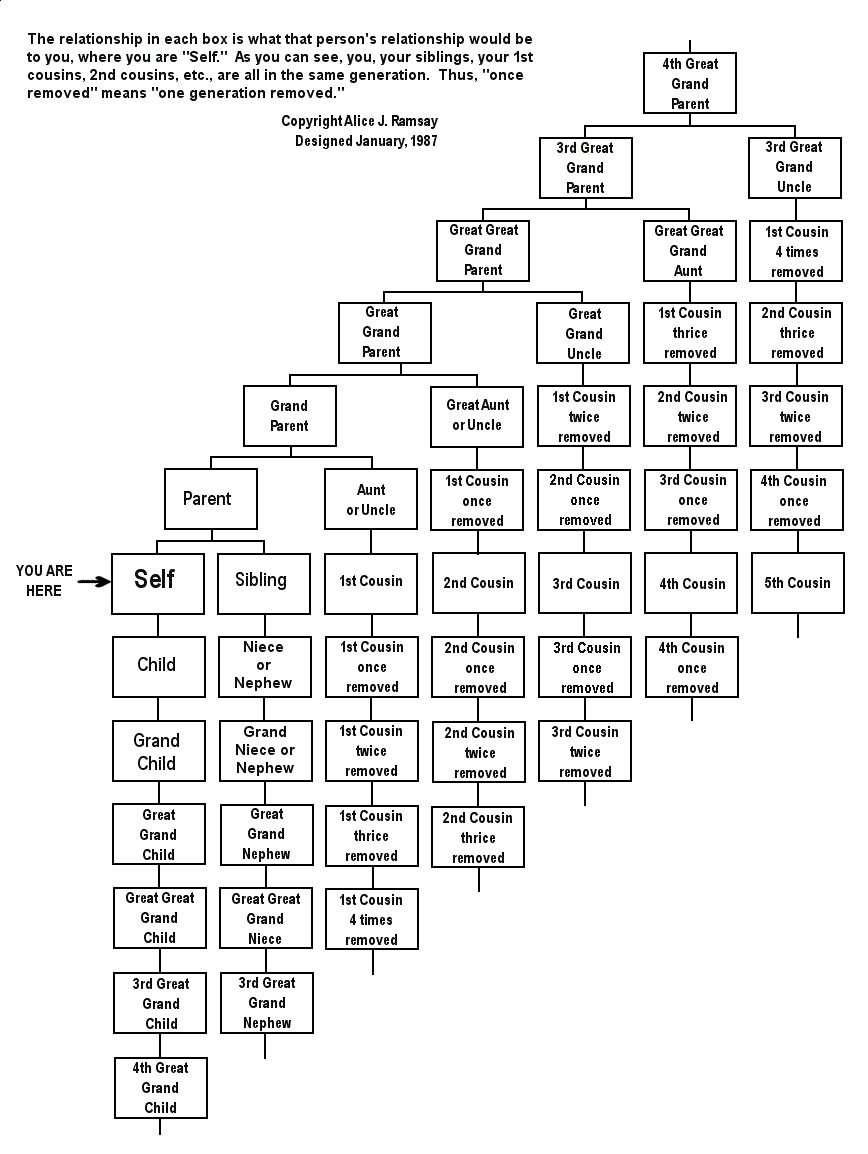
Some time back, curiosity had gotten the better of me in terms of what are the rules of this nomenclature. Turns out there are some fairly nifty rules. The biggest shock I had was that generations way before you can also be your cousin! I always thought cousins are at your own generation or maybe below your generation.

The following chart (thanks to Alice Ramsay) is a neat way to picture it in your mind. If you are more of a rules based person (which is the way I think), this is what I have boiled it down to…

Let say you are trying to find the relationship of person A to you.
Keep traversing up the tree (your parent, A’s parent) till you find a common ancestor.
Let’s say you had to jump “x” steps and A had to jump “y” steps.
Take the minimum of x and y. Let’s say it is “w” (w=x or w=y). Take (w-1)

If (w-1) is at least 1, then A is your (w-1)th cousin. Now take the difference in your generations – which is (x-y). The absolute value is the difference in your generations. Let’ say, that is “d” (x-y=d).

Then A is your (w-1)th cousin, “d” times removed!!

So to calculate your mom’s aunt’s daughter… You have to jump to your mom’s mom’s mom to find a common ancestor. And the other person has to go mom’s mom to get to the same point. Minimum of 3 and 2 is 2. 2-1=1. So the person is your first cousin. Now you had to jump three times to get there and she had to jump twice. Which means the difference in generation is one. (3-2 = 1)

So, she is your first cousin, once removed.

In short, jump from either side till you get a common ancestors. The minimum value in jumps less one is the “what”-eth cousin. The difference in the jumps is the “how much” removed.

What if (w-1) was not at least 1? Then they are siblings (at same generation level) or uncles/aunts at higher generation and nephews/nieces for lower generation. For every generation jump you go Great, Great Grand, Great Great Grand, 3rd Great Grand and so on.

Of course if the jump up and down goes thru you (all points are common ancestor/descendants) then they are your child or parent – with the same Great, Great Grand, Great Great Grand, 3rd Great Grand rule…,

See if the picture makes it easy..

11 October 2020

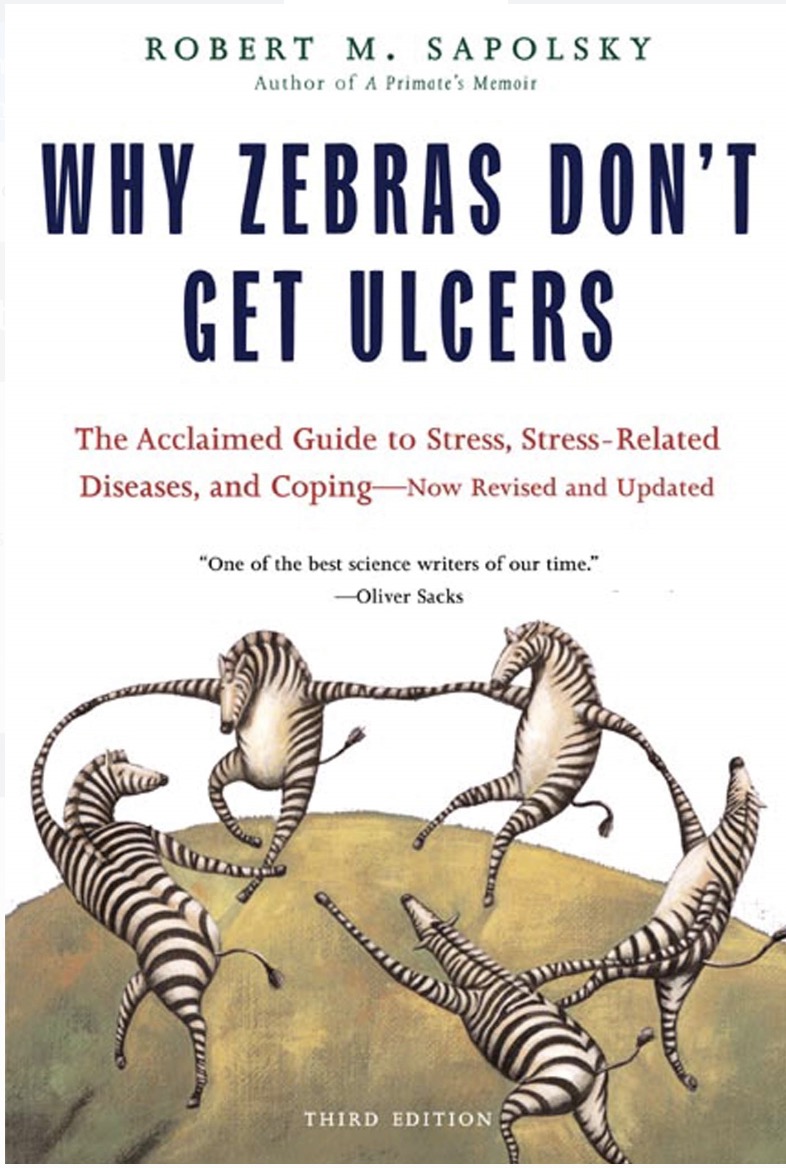
Book Review: Why zebras do not get ulcers

This book took me a lot of time to finish. It is a fairly dense book and filled with too many medical terms that made me slow down to get the full impact. Even then, I suspect I caught only some of the major points.

The author – a neuroendocrinologist from Stanford University – tries to explain how stress messes up pretty much every system we have in our body. The funny title of the book is to highlight the point that humans are the only animals that get stressed about what MIGHT happen in the future.

There are about twenty odd chapters. Each chapter has essentially two parts. The first part explains how a system works – circulatory, nervous, sensory, reproductive etc etc. I found these portions fascinating since it helped me understand a little more about how our body works. The second part of each chapter focuses on how stress – or rather the specific hormone “glucocorticoids” plays havoc with the systems when over produced OVER A LONGER PERIOD OF TIME. I do not believe I could concentrate as much in these portions to follow everything.

Here are some interesting snippets…

1. For the vast majority of beasts on this planet, stress is about a short term crisis, after which it’s either over with or you’re over with. Not so for humans.

2. The diseases that plague us now are ones of slow accumulation of damage – heart disease, cancer, cerebrovascular diseases etc…

3. Our stress response system gets mobilized not only in response to actual stress but in expectations of them too.

4. A funny quote – The sympathetic nervous system mediates the four F’s of behavior – flight, fight, fright and sex. (Get it? 🙂 )

5. No cell in your body is more than five cells away from a blood vessel – yet the circulatory system takes up only 3 percent of body mass.

6. Only vertebrates gain acquired immunity as they grow up. Invertebrates do not. It is not exactly known why this is so.

7. Being under stress does make you more susceptible to cold

8. During stress, memory for emotional components is enhanced (although the accuracy is not necessarily all that good), whereas memory for the neutral details is not.

9. If you test young and old people and give them lots of time to complete an IQ test, there is little difference. As you stress the system – in this case, by making the subjects race against a time limit – scores fall for all ages, but much further among older people.

10. Genes are rarely about inevitability in humans. It is more about propensity and tendency.

I enjoyed the book. Hope you will too!

9 October 2020

Friday evening winding down

This was is from Hakim Momin Khan Momin. Commonly referred to as “Momin”, the poet lived in Delhi and was contemporary to Mirza Ghalib.

“Woh jo humme tumme qaraar thaa
Tumhein yaad ho ke naa yaad ho
Wohi yaani vaada nibhaah kaa
Tumhein yaad ho ke naa yaad ho

Woh jo lutf mujh pe the beshtar
Woh qaram ke thaa mere haal par
Mujhe sab hai yaad zaraa-zaraa
Tumhein yaad ho ke naa yaad ho”

Roughly translated,
“The agreement that we had between us
Maybe you remember, maybe you do not
That promise of being together
Maybe you remember, maybe you do not

That joy that was always with me
That kindness that was bestowed upon me
Every bit of those memories are still with me
Maybe you remember, maybe you do not”

3 October 2020

From the pen of Nasir Kazmi

“Naye kapde badal kar jaun kahan
Aur bal banaun kis ke liye

Wo shakhs to shahar hi chhor gaya
Main bahaar jaaun kiske liye


Jis dhup ki dil ko thandak thi
Wo dhup usi ke saath gayee

In jalti bujhti galiyon mein
Ab khak udaoon kiske liye

Wo shahar mein tha to uske liye
Auron se milna parta tha

Ab aise-waise logon ke naaz
Main uthaun kiske liye

Muddat se koi aaya na gayaa
Sunsaan padi hai ghar ki faza

In khali kamron mein ‘Nasir’
Ab shamma jalaun kis k liye”

The rendition for this evening was by Ustad Gulshan Mir – dad of the Noorani sisters.

18 September 2020

Friday evening … an attempt to get in touch with the soulful side

“Unki nazron ne kuch aisa jadoo kiya
Loot gaye hum to pehli mulaqat mein
Sharaab seekh pe daali,
Kabaab sheeshe mein
Jo baat thi unko kehne ki
Wo baat hi kehna bhul gaye
Gairon ke fasane yaad rahe
Hum apna fasana bhul gaye”

Roughly translated…

“Her mesmerizing glance had this magic on me
I got devastated the first time I met her

(/*so discombobulated I was by her beauty that */)

I poured the wine on barbecue skewers
And served the meat in the chalice

What I was going to chat her up about
I completely forgot to bring up
I remembered to tell the stories of total strangers
But forgot to tell her my own story”

13 September 2020

Finally, some time to enjoy some Qawaali…

Meri nazar ko junoon ka payaam de saaqi
Meri hayaat ko laafani shaam de saaqi
Yeh roz roz ka peene mujhe pasand nahi
Kabhi na hosh mein aaun wo jaam de saaqi

To remind ourselves, “saaqi” refers to the (female) partner that is usually either pouring the drink or accompanying you in drinking.

Oh Saaqi! Give my eyes that vision of frenzy
Offer to my life that evening that dies, Oh Saaqi!
I am tired of this drinking every single evening
This time give me that drink that never gets me back to my senses.

4 September 2020

Friday evening relaxation

From the pen of Fana Bulandshahari. The real name of the poet was Muhammad Haneef. He was born in Bulandshahar (in Uttar Pradesh in India) and derives his second name from that. Fana was the pen name he had adopted.

“Maine maana janaab peeta hoon
Bakhuda Behisaab peeta hoon
Log logon ka khoon peete hain
Main toh phir bhi sharaab peeta hoon

Zindagi ka azaab peeta hoon
Bann ke khana-kharaab peeta hoon
Roz-e-mehshar hisaab ho na sake
Is liye behisaab peeta hoon”

Better translations welcome…

“Agreed, your honor, I am given to drinking
By God, I drink without keeping any count
But other people drink others’ blood often
I am merely given to drinking alcohol

I drink to all the torments of my life
And I drink to my own ruin
Never knew how to count to the Day of Judgment
Never thus knew how to count while drinking