27 November 2020

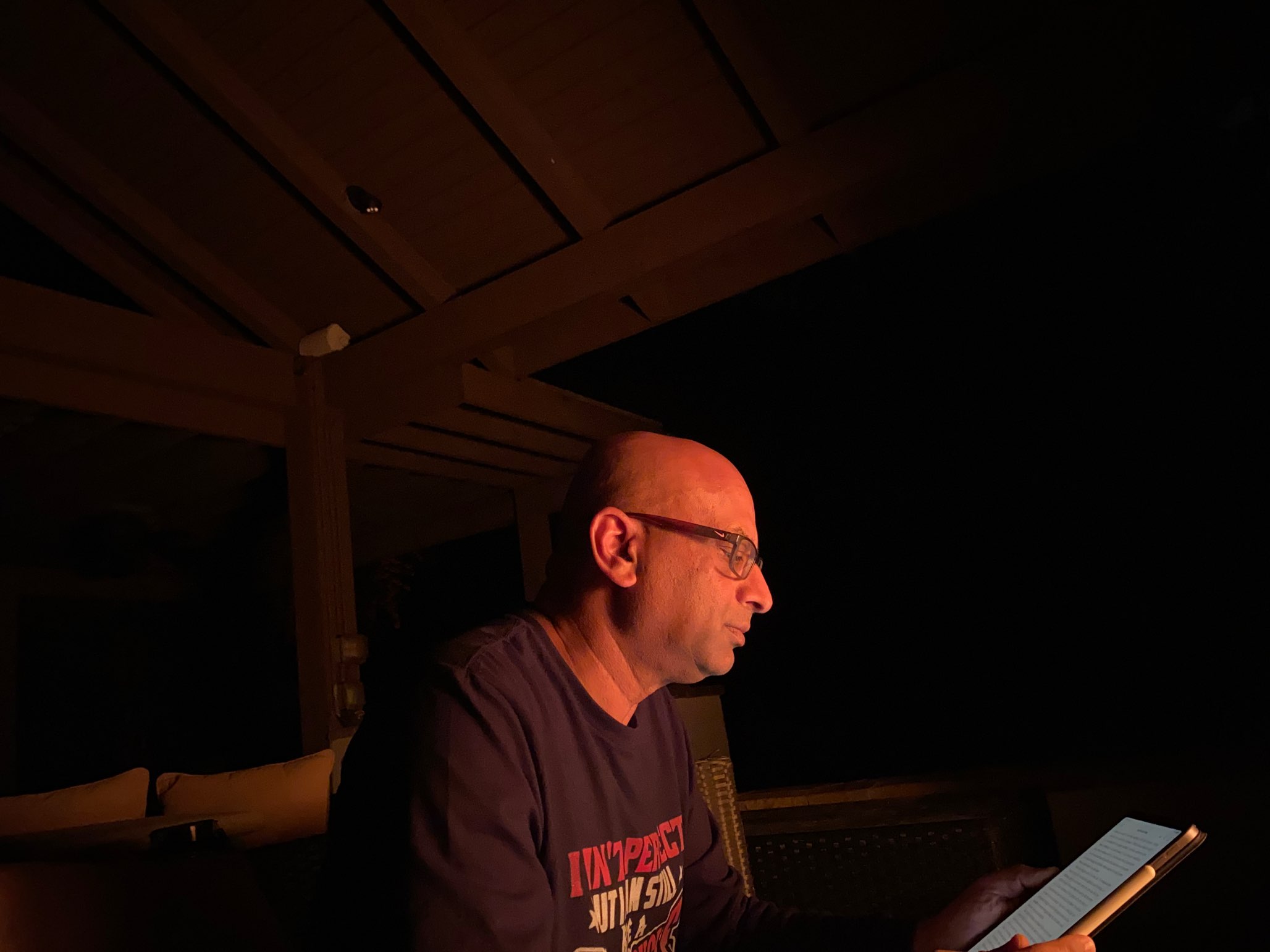
Started a new book…

This time it is a recommendation from Avi Basu – Steven Johnson’s “How We Got To Now”. This book focuses on six inventions and the surprising downstream long term changes they have brought – “Hummingbird Effect” – as he calls it. These are inventions that you will not come up with very quickly – glass, air conditioning etc.

And that is his point – while we easily understand the short term, immediate effect of these inventions, if you think thru it a few more steps, you will realize that the long term effects have been profound for these seemingly innocuous inventions. As an example, he cites how the printing press gave way to our understanding of the edges of the universe.

While the connection is not apparent at first, the author points out how spread of printed material made people realize they are farsighted (could not read as well the smaller scripts) which gave rise to glasses (lenses) which gave rise to microscopes on one end and telescopes on the other. Without the need to read the small print so often, we would have never stumbled upon lenses, the author argues.

Will continue to enjoy reading the book by the fire the next few evenings.

27 November 2020

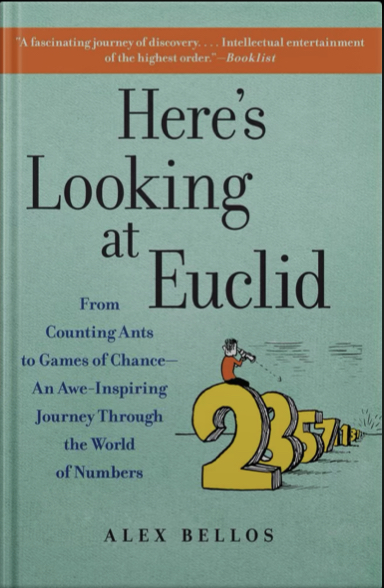
Book Review: Here’s looking at Euclid

This is an absorbing book if you have any cursory interest in numbers and how they came about. Alex Bellos, a British journalist has a good story telling style and presents fairly well some of the mysteries behind numbers.

For example, did you know…
… if we did not go thru math classes, we would naturally think of numbers in logarithmic scale? We would think 1,2,3, a few, many… We understand ratios better than differences. (Remember that example from a previous post on why we would not walk 50 yards to buy a car for one buck less but will do so for a 2-buck coffee?).

… that base 10 is very inconvenient? 12 is the most convenient base (explaining 60 minutes to an hour, 12 inches to a foot…). But 10 became standard because it was easier to count with our fingers that way. Ever wondered why a finger is also called a ‘digit’?

… there are some fascinating stories about Pi. You can read about them in a prior post here

… why do we call a variable “x”? Originally we used upper case vowels for variable and consonants for constants. Descartes switched to lower case. He denoted variables from the end… “z”, “y”… and constants from the front “a”, “b”… But while publishing his book, the printer started running out of “z”s and asked if he could use “x”. (there was not much use of “x” in words). Descartes replied that he did not care. The rest became history. If not for the printer running out of letters, we could have had Z-Rays to check your chest infection today or Malcolm Z !!

… what an ambigram is? See this post on how I now have started writing my name in ambigram.

… that the largest number smaller than 1 simply does NOT exist?

… that leaves tend to sprout out at 137.5 degrees relative to the previous leaf? (if you see from the top of the shoot) This is rooted in the Golden Ratio and Fibonacci sequence. (It maximizes the sunlight the plant can get regardless of the number of leaves)

… (speaking of Fibonacci numbers)… that most flowers have petals that is a number in the Fibonacci sequence? So do the spirals in a pineapple, spruce cones, sunflowers…

This and many other fascinating facts that our teachers never used to make math really interesting to us can be found in this book. You do not need to know math to enjoy this easy reading book

Highly recommend it.

Category: Books | LEAVE A COMMENT
21 November 2020

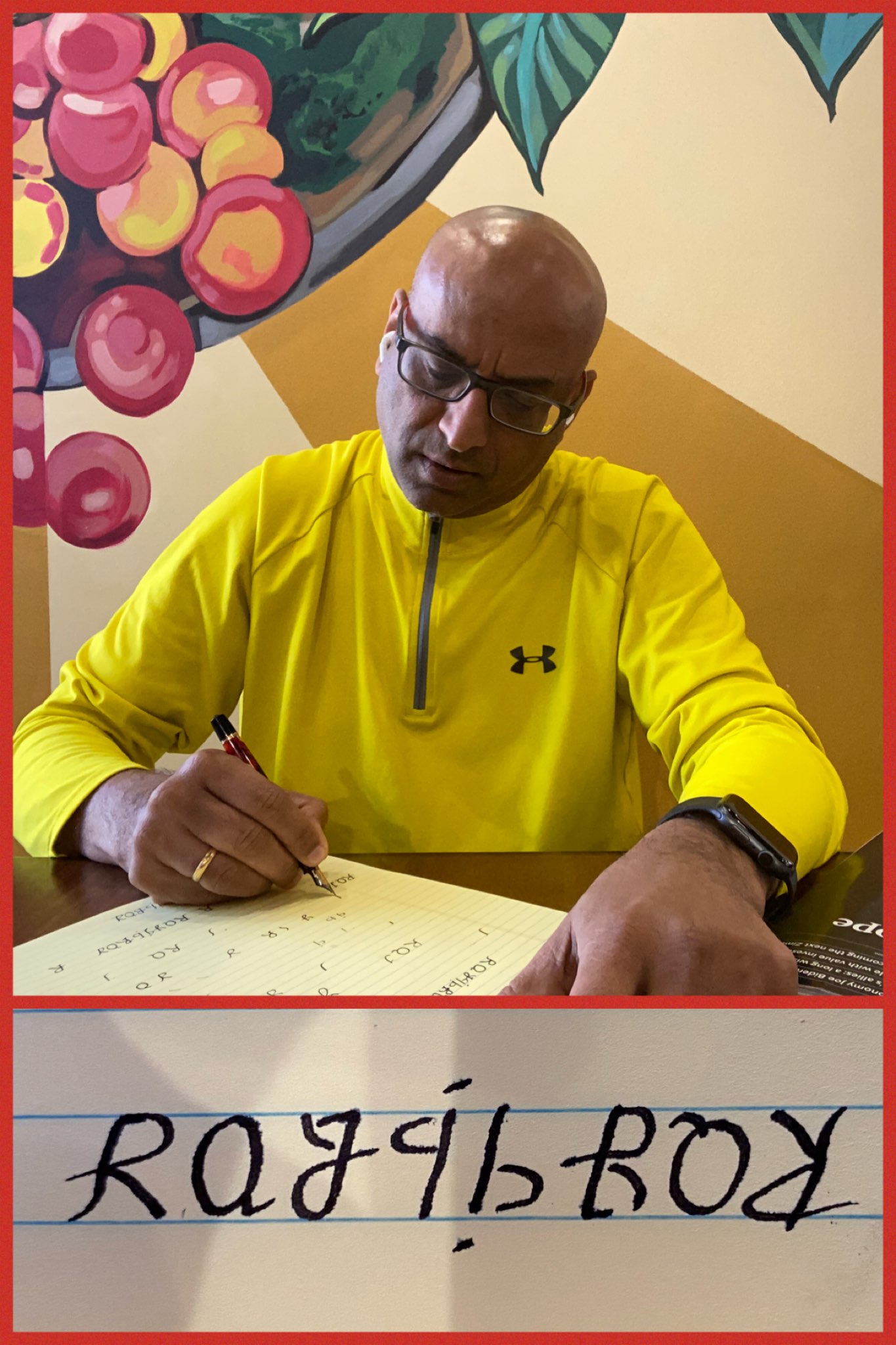
Trying out an ambigram of my name

As I mentioned last night, I learnt about “ambigram”s while reading a book by Alex Bellos. For our purpose, we can say an ambigram is a calligraphic writing such that when you hold the paper upside down, you get the same writing!

That is quite an achievement! I looked up the internet and found some free ambigram generators. I am trying to learn how to write an ambigram of my own name.

It does get your mind to think in a different way when you are practicing every stroke. Basically, you have to think how that stroke will look when you hold it upside down and is it going to build up the other letter you need to build up. (The letter that is as far from the end as is the one you are writing from the beginning). So while writing my first “R”, I have to do it in a way that if I turn it upside down, it should look like the last letter “y” and I have to draw the exact opposite of how I wrote “R” in the end to write “y”.

You will see that after half an hour of trying, my output is still amateurish. You can even spot the mistake I made in the last letter. I also realized that I need to get a thicker nib from the calligraphic pen set than I did this morning.

Category: Musings | LEAVE A COMMENT
20 November 2020

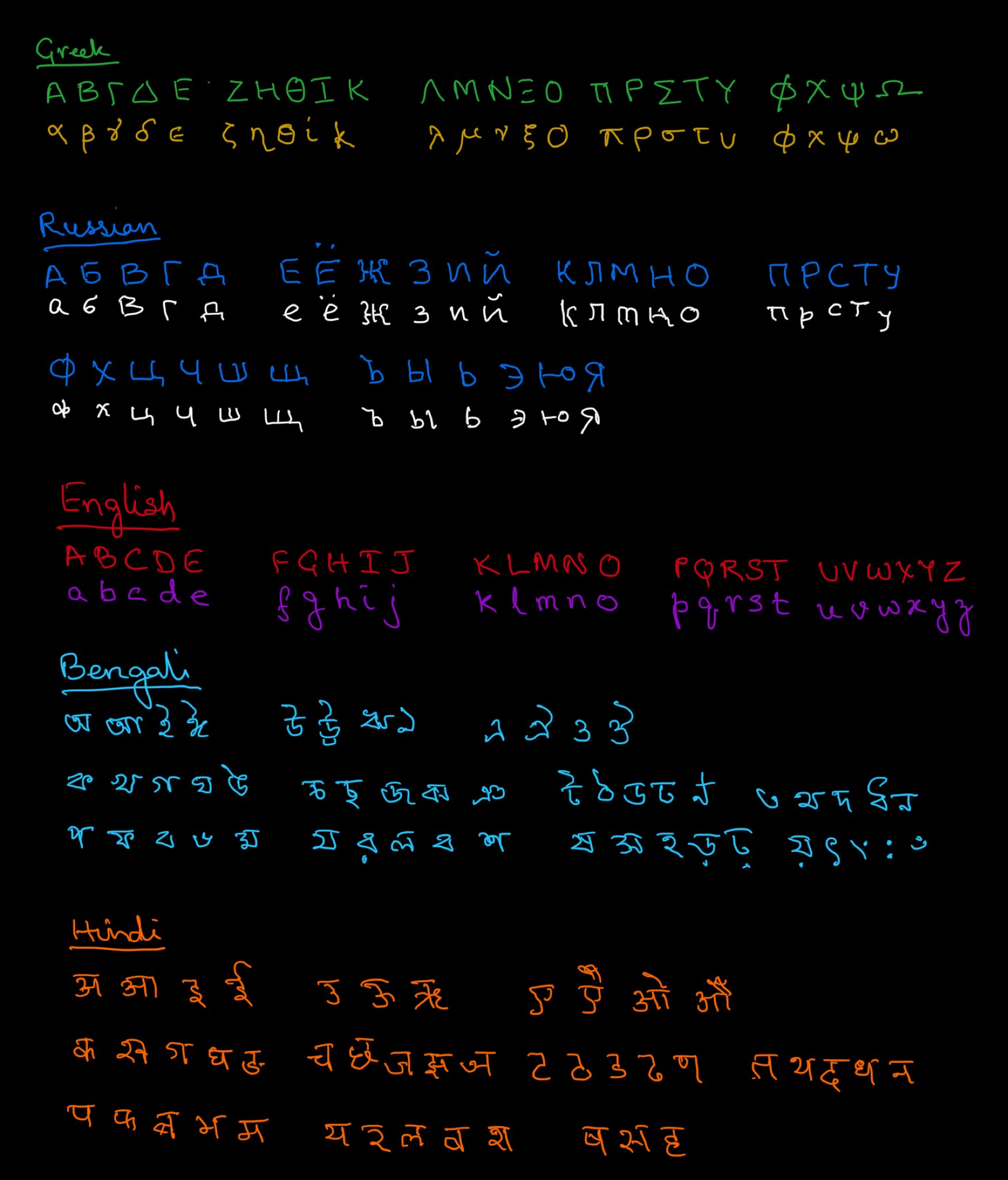
Scripts of five different languages

After storm Zeta and learning the Greek alphabet, I had this crazy idea – albeit not too crazy as far as my ideas go – what if I tried to learn the script of another language?

I remembered, while in Mongolia, I had great difficulty reading their language. So, figured maybe I should try some language with a Cyrillic script. Settled down on Russian. The language has 33 letters and 10 vowels. Eventually got the hang of the upper case and lower case. The pronunciation was a different thing though. There are lots of sounds that are not there in English language (some are there in my mother tongue Bengali). A lot of the letters look like English but have nothing to do with the corresponding English letter. I am still struggling with the difference in pronunciation of “Й” and “ы”. All in all, was interesting to pick this up. I am going to keep trying to identify the letters in words and pronounce them thru the end of this year.

So, with English, Bengali and Hindi (based on Devnagari script), that makes it 5 different scripts for me. (I am not counting German and Spanish since they are too close to English).

Thinking of picking up one more. Tamil has a very different script. At one time, I had taught myself the script (back in 1985). Maybe I will brush that one up…

Category: Musings | LEAVE A COMMENT
15 November 2020

Life of Pi

I was reading up on Pi (the ratio of circumference to diameter of a circle) – in a book by Alex Bellos – and realized how little I knew about this number and how fascinating it is.

For one, all my life, I never realized that Pi can be expressed by this simple formula. Frankly, my first instinct looking at the series was that it does not converge – let alone add up to exactly one fourth Pi !

Ramanujan – who I had heard a lot about when I was growing up in India apparently created a famous formula for Pi – which I did not know either. I was aware of the Ramanujan numbers but not of his work on Pi. The remarkable part of the formula is that right at the outset if you put n=0, it gives an accurate value of Pi to the sixth decimal place! If you put n=1, it will add another eight digits of accuracy to the value of Pi and so on!!

Fairly scary looking formula though:

Modern computers have calculated Pi to – hold your breath – 2.7 trillion places!! To put this in perspective, if we used just 39 places, we can calculate the circumference of the circle that can circumscribe the whole known universe to the accuracy of less than an atom of Hydrogen!!!

And yet, no patterns of repetition (of any set of numbers – two-digited, three-digited…. million-digited …. and so on) has ever been found in that sequence. Thus we know one thing – Pi is NOT a rational number.

Another interesting data and I will let you go… If you start narrating the digits of Pi, you will not encounter a zero in the first 10 digits… or 20 digits… or even in 30 digits. (It comes as the 32nd digit – and yet, the first 200 billion digits in Pi have been studied for distribution – all of them occur in very similar numbers!!)

14 November 2020

Two interesting charts on Covid

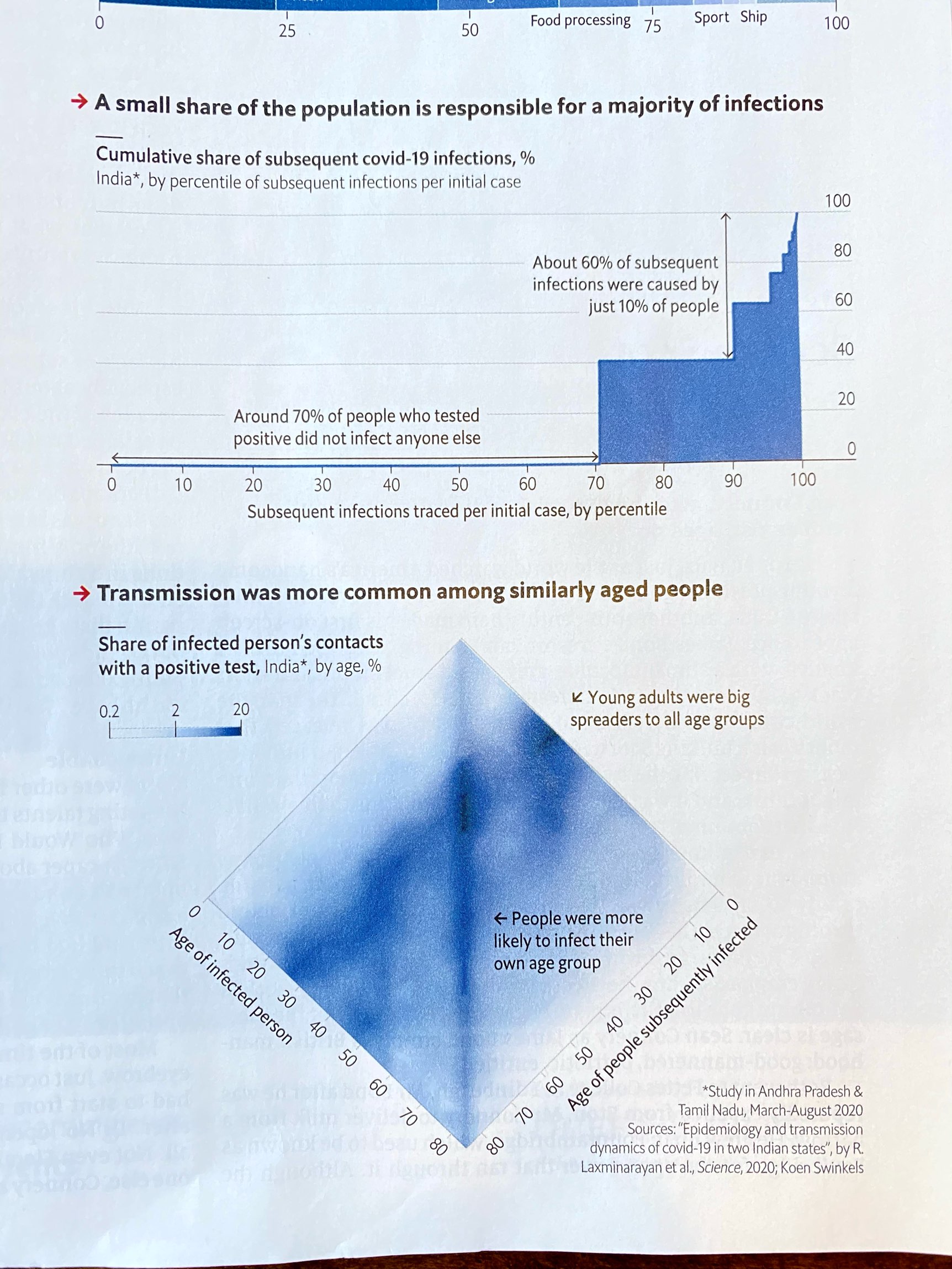
This is data on Covid spread in India. Fascinating data.
1. 70% of Covid patients did not spread the virus to ANYBODY. On the other hand, 10% of Covid patients caused 60% of the spread of virus.

2. The second one is even more fascinating. It is the young adults who are spreading the virus most (I assume that is because they tend to be more social and gather in groups?). And people tend to spread to other people of similar age as their own (I assume because people tend to congregate with folks of similar age group)

(Source: The Economist)

7 November 2020

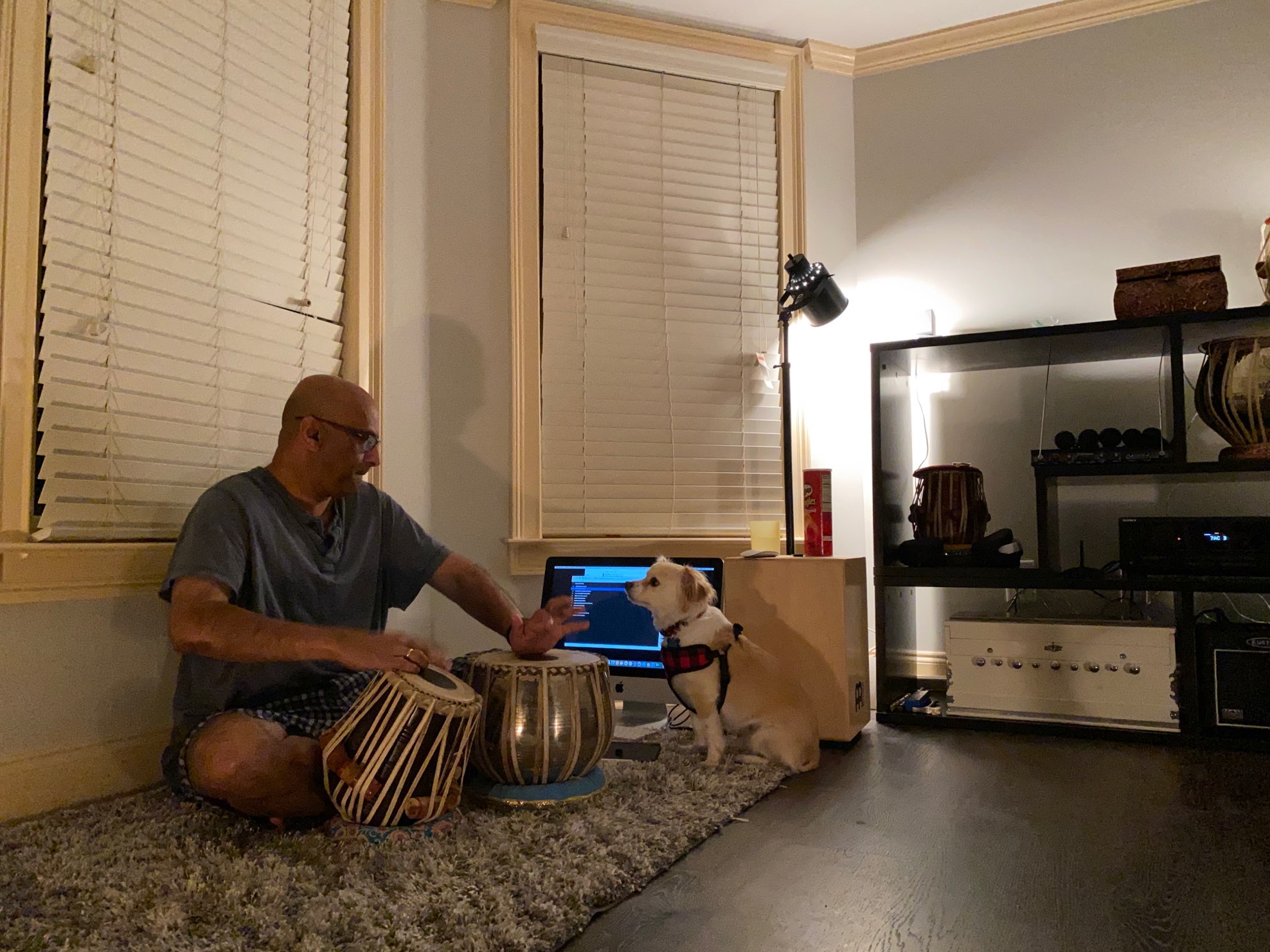
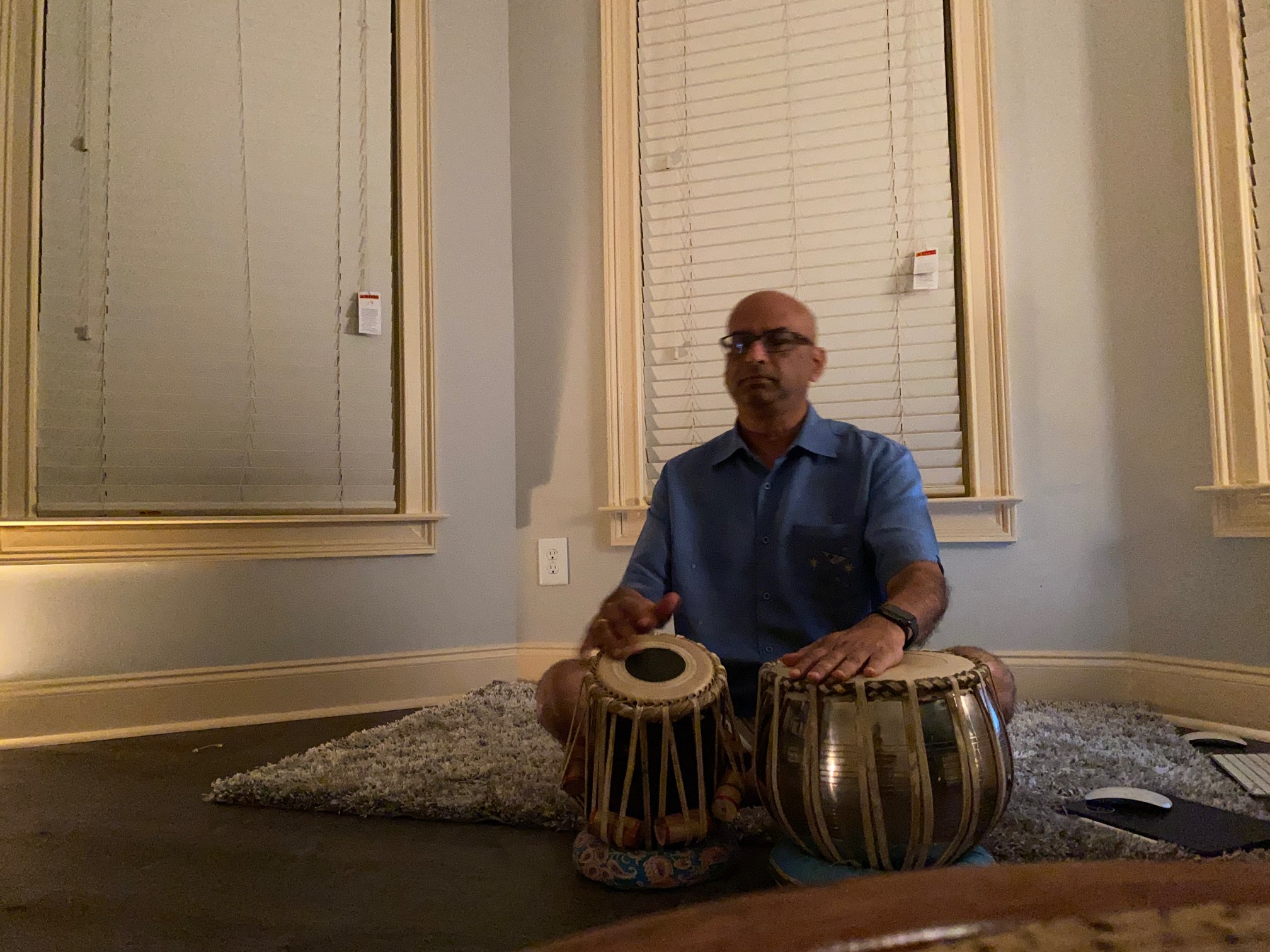
Weekend music session

This one is from Gulzar. We grew up listening a lot to this song. I think this was featured in a Hindi movie. (not an expert on Hindi movies – so not sure of it though)

Naam gum jaayegaa, 
Chehra ye badal jaayegaa,
Meri aawaaz hi pehchaan hai,
‘Gar yaad rahe

Roughly translated…

My name will be lost to your memory
And I will look very different too
But my voice will still be recognizable
Only if you are able to remember it

4 November 2020

Jhorna!! (Bengali alert)

This morning mom reported that amidst the continuous pain my dad is going thru (he is having a real rough time), he had a bright spot when my sister came over and talked about his recitations. My dad used to enjoy reciting Bengali poems – mostly Rabindranath Tagore’s poems. (as in any self-respecting reciter born in the early to mid 1900s Bengal would do).

Looks like he gave it a shot at reciting when my sister brought up the topic.
I asked mom “Which poem did he recite?”
“Nirjhorer swapnobhongo”, she said referring to one of his old time favorites.

Just to engage mom, I asked “What does Nirjhor mean?” After a couple of minutes she gave up. And I let her know the meaning of that Bengali word is a “waterfall” (cataract, cascade).

She immediately asked me “Onno jhorna-r kabita ta mon-e aachhey?”. She enquired if I remembered another famous Bengali poem describing a waterfall. I did remember the one she was referring to. My dad used to recite that one too.

Written by Satyendranath Dutta – often referred to as the Wizard of Rhythm – it is an absolute masterpiece. Each and every word is golden. But the cadence/tempo of the words as you recite them is impossible to forget. There is no amount of translation that can do justice to the words. Certainly there is no way of carrying the rhythm in any translation.

I did remember the first paragraph. It has been impossible to forget ever since our Bengali teacher in eighth grade – Mrs. Gita Mitra – had taught this poem. Such lilting and catchy is the tempo.

Later looked up the whole poem. Turns out I had forgotten most of the rest of the poem. Which is a shame. It is an absolute gem of a poetic talent. Here is the whole poem for my Bengali friends…

—
ঝর্ণা ! ঝর্ণা ! সুন্দরী ঝর্ণা !
তরলিত চন্দ্রিকা ! চন্দন-বর্ণা !
অঞ্চল সিঞ্চিত গৈরিকে স্বর্ণে,
গিরি-মল্লিকা দোলে কুন্তলে কর্ণে,
তনু ভরি’ যৌবন, তাপসী অপর্ণা !
ঝর্ণা !

পাষাণের স্নেহধারা ! তুষারের বিন্দু !
ডাকে তোরে চিত-লোল উতরোল সিন্ধু |
মেঘ হানে জুঁইফুলী বৃষ্টি ও-অঙ্গে,
চুমা-চুম্ কীর হারে চাঁদ ঘেরে রঙ্গে,
ধূলা-ভরা দ্যায় ধরা তোর লাগি ধর্ণা !
ঝর্ণা !

এস তৃষার দেশে এস কলহাস্যে-
গিরি-দরী-বিহীরিনী হরিনীর লাস্যে,
ধূসরের ঊষরের কর তুমি অন্ত,
শ্যামলিয়া ও পরশে কর গো শ্রীমন্ত;
ভরা ঘট এস নিয়ে ভরসায় ভর্ণা;
ঝর্ণা !

শৈলের পৈঠৈয় এস তনুগত্রী !
পাহাড়ে বুক-চেরা এস প্রেমদাত্রী !
পান্নার অঞ্জলি দিতে দিতে আয় গো,
হরিচরণ-চ্যুতা গঙ্গার প্রায় গো,
স্বর্গের সুধা আনো মর্ত্যে সুপর্ণা !
ঝর্ণা !

মঞ্জুল ও-হাসির বেলোয়ারি আওয়াজে
ওলো চঞ্চলা ! তোর পথ হল ছাওয়া যে !
মোতিয়া মোতির কুঁড়ি মূরছে ও-অলকে;
মেখলায়, মরি মরি, রামধনু ঝলকে
তুমি স্বপ্নের সখী বিদ্যুত্পর্ণা
ঝর্ণা !
—-