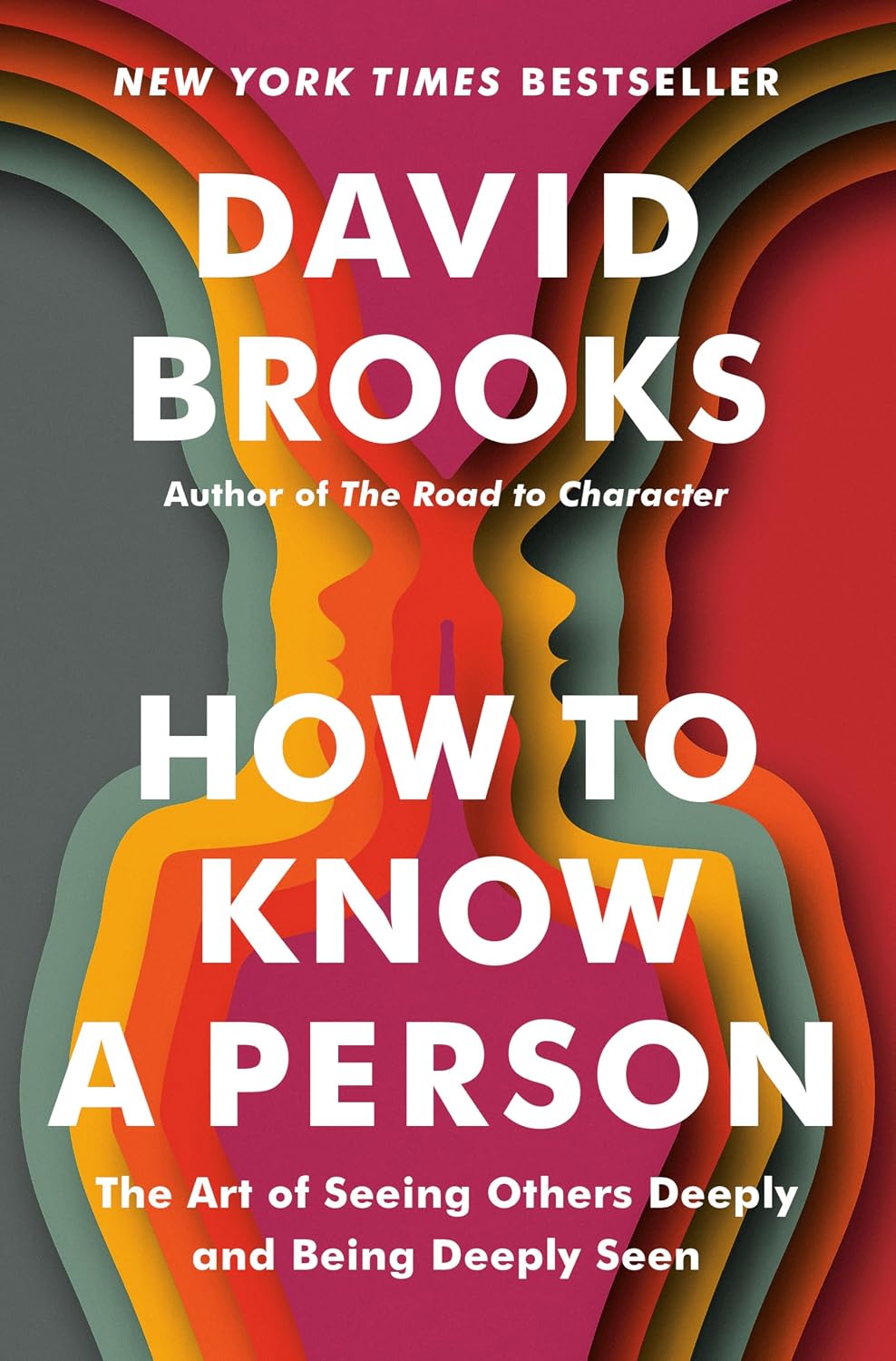
Book Review: How to Know a Person by David Brooks
If you are one of Facebook friends, who in the last couple of months had referred to this book in one of your posts, can you please stand up? For the life of me, I cannot remember whose post it was. But thanks for pointing me to a good book.
This is a book about how to authentically “see” a person – to get to know someone in the truest sense of the phrase. There are plenty of interesting insights and thought-provoking ideas throughout. I especially enjoyed the stories Brooks weaves in, along with the quotes from journalists, authors, and philosophers.
Brooks begins by laying out the many reasons we fail to truly see other people: egotism, anxiety, naive realism, the “lesser minds” problem (we have much richer access to our own thoughts than to anyone else’s), a static mindset (holding on to an outdated conception of someone), essentialism (stereotyping), and more.
The next part focuses on how to actually see another person. Brooks goes beyond the usual advice about empathy and listening and offers a framework for recognizing another person for who they really are. He explores the ways our mental shortcuts distort our view of others – and how to avoid those traps.
For example, while explaining “naive realism” – the assumption that our reality is essentially the same as someone else’s – he tells a memorable story. A woman standing on one side of a river calls out to a man on the opposite bank, “How do I get to the other side of the river?” Confused, the man shouts back, “But you are on the other side of the river!”
The biggest challenge to seeing another person, Brooks argues, is understanding the complexity of being human. Our brains naturally prefer simplicity. It is much easier to slap broad labels on people – kind, wicked, generous, selfish – as though those words describe them at every moment. But human beings are full of contradictions. We recognize that complexity in ourselves, yet often fail to see it in others.
Small talk and simply spending time around someone are also vastly underappreciated parts of getting to know a person. You do not always need a probing conversation. Sometimes, you need to hold back and allow the other person to move at their own pace.
Brooks then delves into the question of what makes a person a person. In trying to understand someone’s experiences, he points out that the events themselves are not the whole story. What matters is how the person processed those events. As Aldous Huxley put it, “Experience is not what happens to you; it’s what you do with what happens to you.” Anaïs Nin expresses a similar idea: “We do not see things as they are; we see things as we are.”
I thought this was a particularly powerful perspective. A person, then, is simply a point of view.
That naturally raises another question: Is there such a thing as objective reality? Brooks’ answer is that yes, objective reality exists – but we only have subjective access to it.
From there, his conclusion follows quite logically: to see a person – to see someone who is, in part, a point of view – you have to understand how they see the world. Brooks offers practical suggestions for doing that: treat attention as an on/off switch rather than a dimmer, be a “loud listener,” do not fear pauses, and so on. One technique I particularly liked was asking detailed questions from time to time, so that the other person becomes the author of the conversation rather than merely a witness to it.
Brooks also offers another useful frame for understanding people: seeing them both as individuals and as members of groups. A person’s community, ethnicity, culture, or tribe inevitably shapes how they see the world. But none of those categories fully defines the individual. To truly see someone, you have to consider both the individual and the broader groups that have shaped them.
The book also gets into education and parenting. Brooks argues that our schools – and, to some extent, our homes – have become overly focused on achievement. We want kids to excel at math, sports, music, or some other measurable skill, while paying less attention to teaching the moral skills that help people treat one another with kindness, generosity, and respect. My mind went back to a subject we used to be taught in school – “Moral Science.” I might have underestimated the value of that class.
One section surprised me. I consider myself fairly introspective, and I have always felt that introspection has helped me. But Brooks points to research suggesting that introspection is overrated. What is happening in our minds is not only more complicated than what we understand; it is more complicated than what we can understand.
I also learned that the Myers-Briggs personality test has no strong scientific validity. I have never been a big fan of those tests anyway – I find it hard to believe that a point-in-time evaluation can meaningfully capture a person’s personality – so now I have one more reason to complain to my HR department!
A couple of other quotes I liked:
“Washington is not filled with wild kids who stuck the cat in the dryer; it’s filled with the kind of kids who ratted on the kids who stuck the cat in the dryer.” – journalist Meg Greenfield
“You can be knowledgeable with other men’s knowledge, but you can’t be wise with other men’s wisdom.” – Montaigne
Overall, I found the book to be thoughtful, accessible, and full of ideas worth carrying into everyday life. The central lesson sounds simple – really see the people around you – but Brooks does a good job showing just how difficult that is, and how much better our relationships might be if we made the effort.