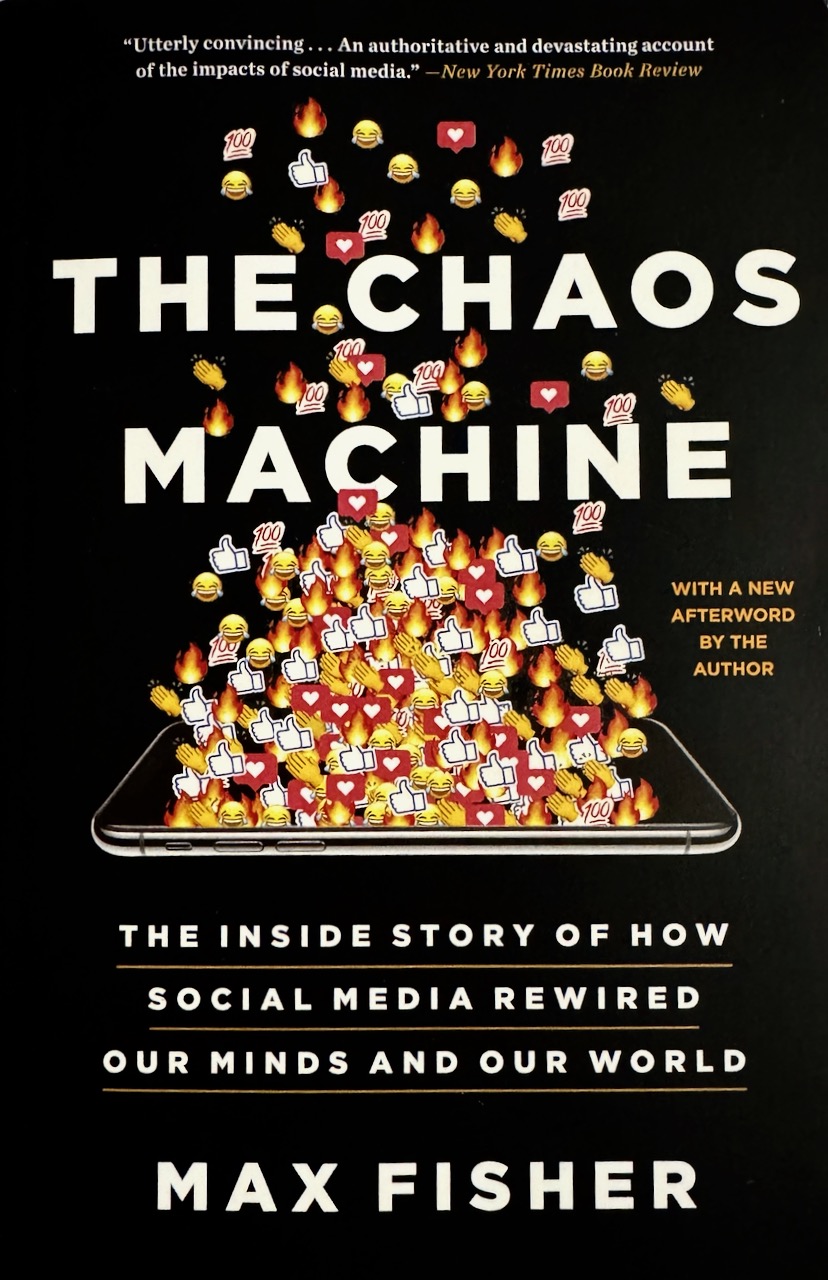
Book Review: The Chaos Machine by Max Fisher
I forget how I landed up with this book. I think I was reading an article in The Economist that mentioned this book.
It is a fascinating book to understand what causes some of the grave ills of social media. I used to see all the young kids constantly on their phones. But from The Economist article, I learnt that constant social media doomscrolling is affecting the older generation even worse.
The author does not delve very deep into certain aspects of psychiatric issues caused by social media, like loneliness, anxiety, and so on. Instead, he focuses much more on how social media causes mass hysteria around conspiracy theories and deep echo chambers, to the point that ordinary people are becoming unhinged from reality.
He has studied Facebook and YouTube in the greatest detail. Interestingly, not much analysis of TikTok was presented, but he suggests that its algorithms are doing exactly the same.
It stems from the social media company single-mindedly chasing screen time – or the user’s attention. This is clearly driven by profit motives (ad revenue is proportional to the time you spend on an app or site).
As a second step, the social media companies created algorithms to feed you more stuff that they deem will keep you on the screen. The algorithms have developed this magic by constantly studying the behavior of millions of human beings. In and of itself, it does not have any value judgment – but a very good idea – based on data, what will make you stay on the screen.
And the third part is the foible of us human beings. We are attracted to salacious news items. We discount data that goes against our beliefs and instead are likely to believe more data that supports our belief – even after we are told that the data source is spurious!! And if enough people say it, we take it as a cardinal truth.
All this, when done on a large scale – where no human being can truly understand the AI algorithm’s complexity anymore – leads to extreme behavior from human beings. To the point, people have killed people – and in extreme cases, genocides like that in Myanmar – purely based on believing something to be true since the algorithms kept feeding one kind of item only.
The author has a strong point of view: owners of social media need to bear significant responsibility for this and should be held accountable. The owners, on the other hand, claim that it would be a violation of free speech. They have sometimes taken action when faced with political or social pressure, but things regressed soon after.
I think the problem manifestation is clear (people are killing people, and human beings are suffering from deep psychological issues – this is undeniable). However, the solution is equally unclear. In fact, the author does not seem to offer any elegant solution beyond suggesting that we hold social media owners responsible for what their algorithms do.
I would recommend reading this book.