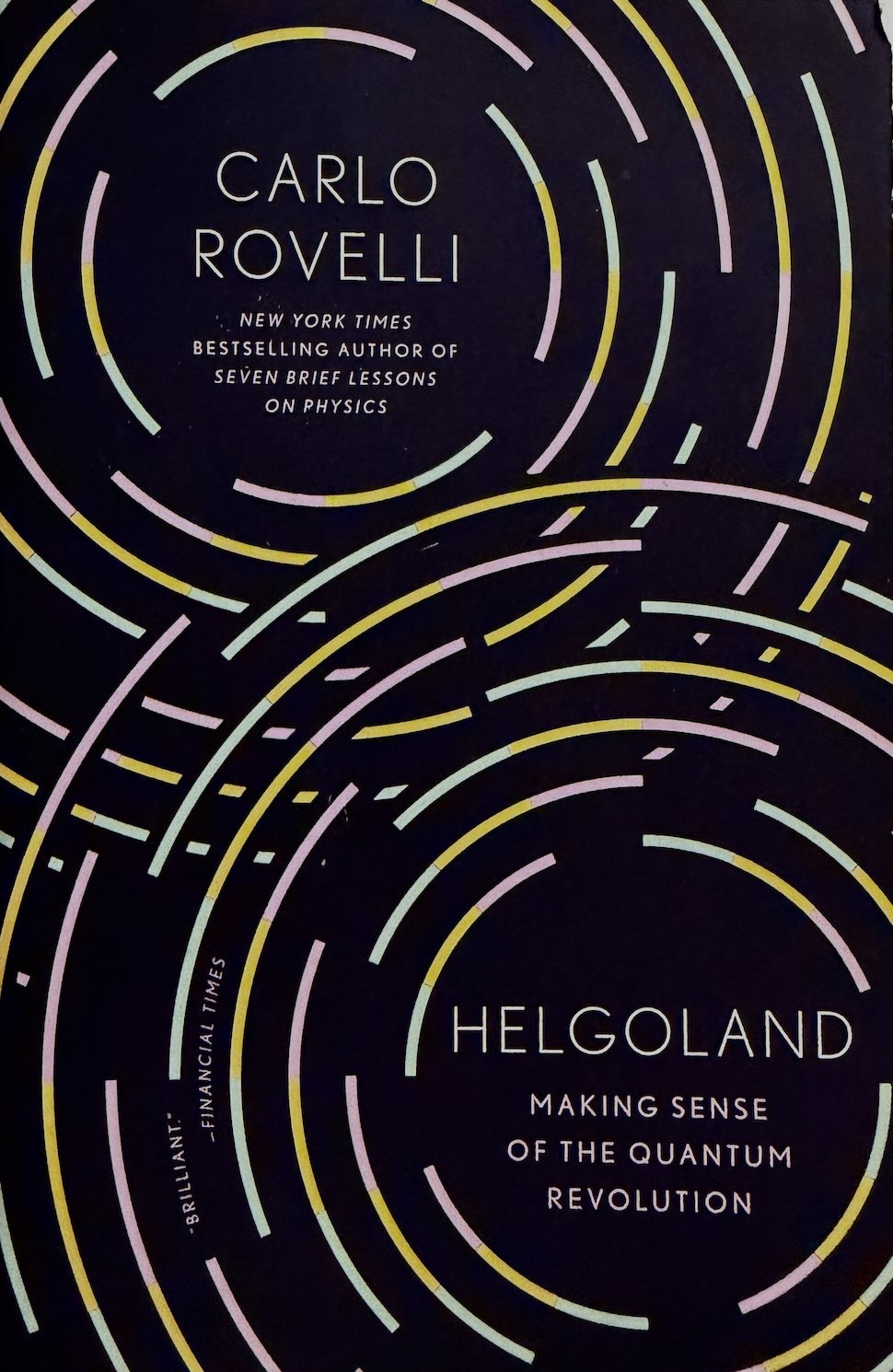
Book Review: Helgoland by Carlo Rovelli
“Making Sense of the Quantum Revolution”
I think it was John McGehee who recommended this book in a Facebook comment. I’m genuinely grateful to him, because this turned out to be a fantastic read. It’s especially insightful for a layperson like me. At times it does get confusing, but that’s the nature of the subject, not a failing of the author.
My biggest aha moment came when Rovelli explains that what we think of as an object’s properties are actually relative to the observer. If we could not observe something, we would not even think of it as having properties. Quantum physics started to feel a bit more approachable once I grasped this core idea: reality is made up of relations rather than objects.
The explanation of superposition, especially when it involves understanding entanglement between two objects from the perspective of a third observer, was harder to wrap my head around.
One thing I really enjoyed was how Rovelli weaves in the personal histories of the great physicists in this field. It adds a human touch to an otherwise abstract topic. In the second half of the book, he dives into philosophical debates, particularly between Lenin and Bogdanov, and questions like “What does meaning mean?” I’ll admit, I sometimes wondered what this had to do with quantum physics, but the writing is clear and engaging enough that I still enjoyed it.
There’s a striking line in the book: “I is a process, not an entity.” It takes a bit of thought to unpack. What we call the “self” isn’t really a fixed object, but a flow of sensations and feelings we experience in the moment.
My favorite quote, though, comes from the nineteenth-century French philosopher Hippolyte Taine. Rovelli uses it while discussing how we perceive the world. It’s not that we passively receive signals and then interpret them. The brain is constantly predicting, and the eyes mainly report deviations from those predictions. The quote goes:
“External perception is an internal dream which proves to be in harmony with external things; and instead of calling ‘hallucination’ a false perception, we must call external perception ‘a confirmed hallucination’.”
That one really stayed with me.
A few other memorable lines from the book:
“Abandoning assumptions that seem self-evident can lead to greater understanding.”
“Never express more clearly than you are able to think.” (Niels Bohr)
“However mysterious the mind-body problem might be for us, we should always remember that it is a solved problem for nature.”
“The external point of view does not exist. Every description of the world is from inside it.”
I wholeheartedly recommend this book.