23 June 2021

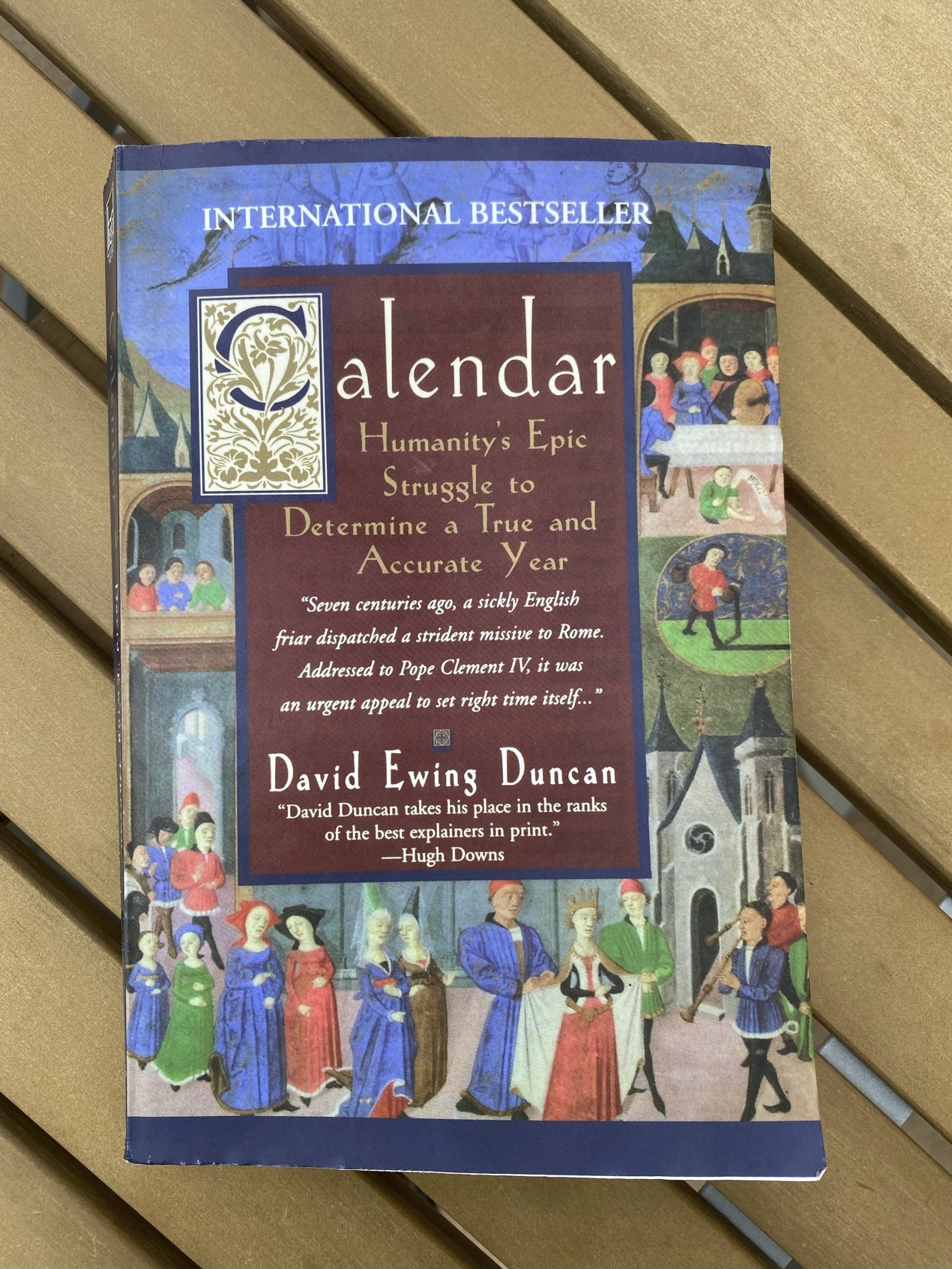
Book Review: Calendar – Humanity’s Epic struggle to Determine a True and Accurate Year

Book Review: Calendar – Humanity’s Epic struggle to Determine a True and Accurate Year
David Ewing Duncan

I am not sure who had referred me to this book, but it was in the comment section of some other Book Review I had written. Unfortunately, this book is not available in the digital format. I got the paper version, but since I do not often carry a book with me, I never got around to actually reading this. Till now.

A fascinating book on how we came up with calendars. The numerous mistakes, the number of lives lost (yes, just because of calendar design), the arbitrary dropping of dates in calendar (different countries did in different times) all make for a great read. The author narrates this more as a history lesson than anything else. And he does a great job.

He starts almost on a philosophical note when he talks about how today, we are constantly looking backward and forward in time but never contented with the present. In a way that our ancestors who tilled fields and lived and died according to the great cycles of nature would have never comprehended.

The story he takes us thru starts with the Cro-Magnon man. One of whom would have realized the curious nature of how the moon every night changed and came back to the same position ever so often (about 29 days) as evidenced in bones with telling marks from those days. And thus, almost all calendar journeys for us started with the moon and lunar calendars. Even to this date, lunar calendars are followed in many parts of the world (including my own Bengali calendar – which has been later adapted to take into account the sun’s movement).

Later, the need to take into account the “seasons” came in – especially as farming and harvesting became more prevalent. And that started the eternal struggle to figure out how to calculate a calendar year. Because any which way we divided the cycle of seasons (about 365 days and change) it could never fit well within an integral number of cycles of the moon (about 29 days and change). The resultant was that for the most of the our known human history, our seasons and equinoxes and all that never came “on time”. We were always in error.

The Babylonians, who were very good in astronomy compromised with a “lunisolar” year but it was the Egyptians that truly embraced the sun and ditched the moon to fix the “year”. They Mayans came up with an even more complicated calendar (it was a three calendar system). The Egyptians had figured out that there was another quarter day after 365 to make it a full year but they ignored it for the most part.

The Romans, in the meanwhile, were a mess. It was Caesar who after coming to help Cleopatra got to know about the Egyptian system and then more or less bulldozed a far more modern system in the Roman empire. Which continued for a fairly long time.

Eventually, biggest need for time accuracy that the West felt was the Easter date. The most sacred date at that point of time, celebrations of the same would have been blasphemy if it did not happen on the right date. Ironically, the calendar then was somewhat of a “secret” with the church having a stranglehold on it and they would announce dates often abruptly. Sometimes to favor themselves or kings they liked.

It was Constantine who gave the next big thrust to fixing a calendar year with the great conference in Nicaea that more or less standardized the calculation of the Easter day. It was a fairly onerous task involving nearly 15 equations.

Then came a long period of decline of the Church, the Roman Empire and the West in general. Meanwhile, Islam started their own calendar and the fact that the Indian and Chinese had their own calendars (all mostly moon based) came to the fore as knowledge of other lands started gaining a stronghold in the West.

While Aryabhata from India was a big influence in how the calendar eventually shaped up, the Indian civilizations biggest contribution to the calendar was possibly cracking the positional system. Like 365 means 3 hundreds, 6 tens and 5 unit. It seems so natural now – but imagine the world before that. Just think about the Roman numerals that we are so familiar with. Here is a paradox – even though the Indians knew and depicted fractions (one number up, one number down) – it is not known why they never cracked the decimal system (which is also positional) to represent fractions.

Interestingly, that simple twist delayed the calendar year determination. Basically, we did not know how to represent what we already knew (couldn’t write fractions !!). The Arabs cracked that problem and then they get the credit for calculating a year to the greatest accuracy in those days (12 digits after the decimal). The Europeans did not care about the importance of this “slip”. Incidentally, the person who calculated this is Omar Khayyam. Most of us in the West think of him as the brilliant poet. He was much more.

In the West, the Church continued to thwart efforts by others like Copernicus, Galileo to scientifically fix the year in what can be described as the Dark Ages of the Calendar. Eventually, Pope Gregory XIII called a Niceae style conference to resolve the Easter date once and for all. The person who gets full credit for solving the calendar problem finally is one doctor called Aloysius Lilius who was not even alive when the conference took place. His brother presented his case – with a lot of support from Clavius.

Just because this Gegorian calendar was enacted in 1582 does not mean everybody adopted it. The Protestant countries simply refused to, as an example – for no other reason than that it was done by the Catholic Pope! But the other reason was that this change involved dropping 10 days from the calendar to make adjustments to prior errors. Politicians, true to their colors, often used this to confuse the masses who were completely irate that somebody was “stealing 10 days of their lives”. England waited nearly 150 years! Japan adopted in 1873! Russia in 1918 !! China in 1949 !

And then in 1972, we switched to following the oscillations of a Caesium atom to determine a year (about 3 million trillion oscillations) for accuracy – and sometimes in a year adjust the clock by a second to take into account the variations in earth’s speed and tilt. But for the common man, we stay with the 365 days, one leap day every four years, but no leap day on the century year unless it is divisible by 400, in which case, we will have a leap day. For the most part, this will work out for the next 3 thousand years.

Two thumbs up! If anybody in Atlanta wants it, you can borrow my copy. (Too many highlighter marked passages though)
Category: Books | LEAVE A COMMENT
21 June 2021

The apostrophe that bothers me…

After going thru all the posts in FB on Father’s Day, the stickler in me has a question – why do we write “Father’s Day”. It should be Fathers’ Day – right? (It is wishing all fathers). Just like we write Children’s Day (not Child’s Day) and Presidents’ Day (not President’s Day).

Google it up – it is always Father’s Day and not Fathers’ Day. Does not make sense to me.

Also, in that line, even more confusing is “Veterans Day”. There is no apostrophe at all!

I am not saying this impedes basic communication.

After all, It is not a catastrophe.

But still, it is an apostrophe.

Category: Musings | LEAVE A COMMENT
6 June 2021

Book Review: “Nine Lies About Work”

This book was referred to me by Juli Johnson from our company. I believe there is an audio book version of this. I am still a “you read a book, not hear it” kind of guy 🙂

First, this is a very atypical book for me to review – I usually do not study too many books that has to do with work. Second, I am very, very skeptical of any book or any person who tries to teach how to manage talent. My personal experience is that every human being is unique and trying to generalize anything as talent principles is at best, misguided. Remember those books from a few years back that were inspired by Jack Welch’s views on how to deal with the “bottom 10%”. Yes? Good. I am using some of them as doorstop for my music room. Right next to the books on Atkinson’s diet, Paleo diet etc.

Of course, the answer cannot be to throw away everything. You still need some kind of framework of thinking. The key point is to understand that every aspect of talent management is, in all likelihood, over generalization or sometimes, outright, wrong. In fact, most of the “research” cited have one common flaw – they cannot control for other variables. And when we talk about human beings – it is very difficult to control for “other” variables.

The point is to be aware of these flaws in any system. This allows one to recognize the limitations of the frameworks and therefore allows for judgmental calls. As infuriating as it can be (“Where is the fairness?”), evaluating any professional is fundamentally a subjective call. It is subjective depending on the rater, the rated and even the time when the rating is done.

If not anything else, this book will make you think of how deeply flawed our basic assumptions and often quoted, catchy phrases about Talent management is. I also want to suggest that the authors do not necessarily give answers that always make much sense to me. Some do. But maybe you will understand the others better than me.

Here are the top 9 Lies the authors want to highlight to you. The portions in [ ] are my comments. The rest are from the book.

Lie #1: People care which company they work for
People might care about which company they join, but after that, they care which team they are on.

Lie #2: The best plan wins
Company level plans do not predict the future. It merely tells you where you are. The world moves too fast for plans. What wins is providing data and intelligence (what is happening) to everybody quickly and accurately.

Lie #3: The best companies cascade goals
Company goals top down defeats the purpose. Better way would be show the employees what you value. And let the goal setting happen locally.

Lie #4: The best people are well rounded
[This one spoke a lot to me; I still get miffed by performance reviews that talk about Strengths and Weaknesses].
Best people are spiky. They excel in one or two things. Better than most. And they leverage this/these traits to produce outsize results. Uniqueness is a feature. Not a bug.

Lie #5: People need feedback
People need attention. Not feedback. The attention people need is to what they are doing best – not what they are not doing well. We all want to be seen for what we are best at.

Lie #6: People can reliably rate other people.
[This one spoke to me a lot too. If you get a chance, look up Idiosyncratic Rate Effect].
Most raters are terrible in judging others – if there was even a benchmark to measure against. They have deep biases and often are judging based on very little data. What we can reliably rate is our own experience.

Lie #7: People have potential
Like potential is a thing inherent to a person (like a trait). This is a function of the environment and opportunities as much as the person. Every brain is capable of learning – the speed differs based on the environment and opportunities. People have different momentum – we move through the world differently depending upon environment and opportunities.

Lie #8: Work-life balance matters most
Love in work matters most. That is what work is really for.

Lie #9: Leadership is a thing
[This, I found very interesting.]
There is no such thing as leadership skills. Take the name of 10 leaders and you will see there is no pattern to their traits. Some like Steve Jobs was even lacking in some basic ethics area. What does make a leader a leader – and this is a common trait – is that they have followers.
[The authors then spend quite a few pages on why people follow. I found that very intriguing.]

Highly recommend you read it if you care about talent issues.

16 May 2021

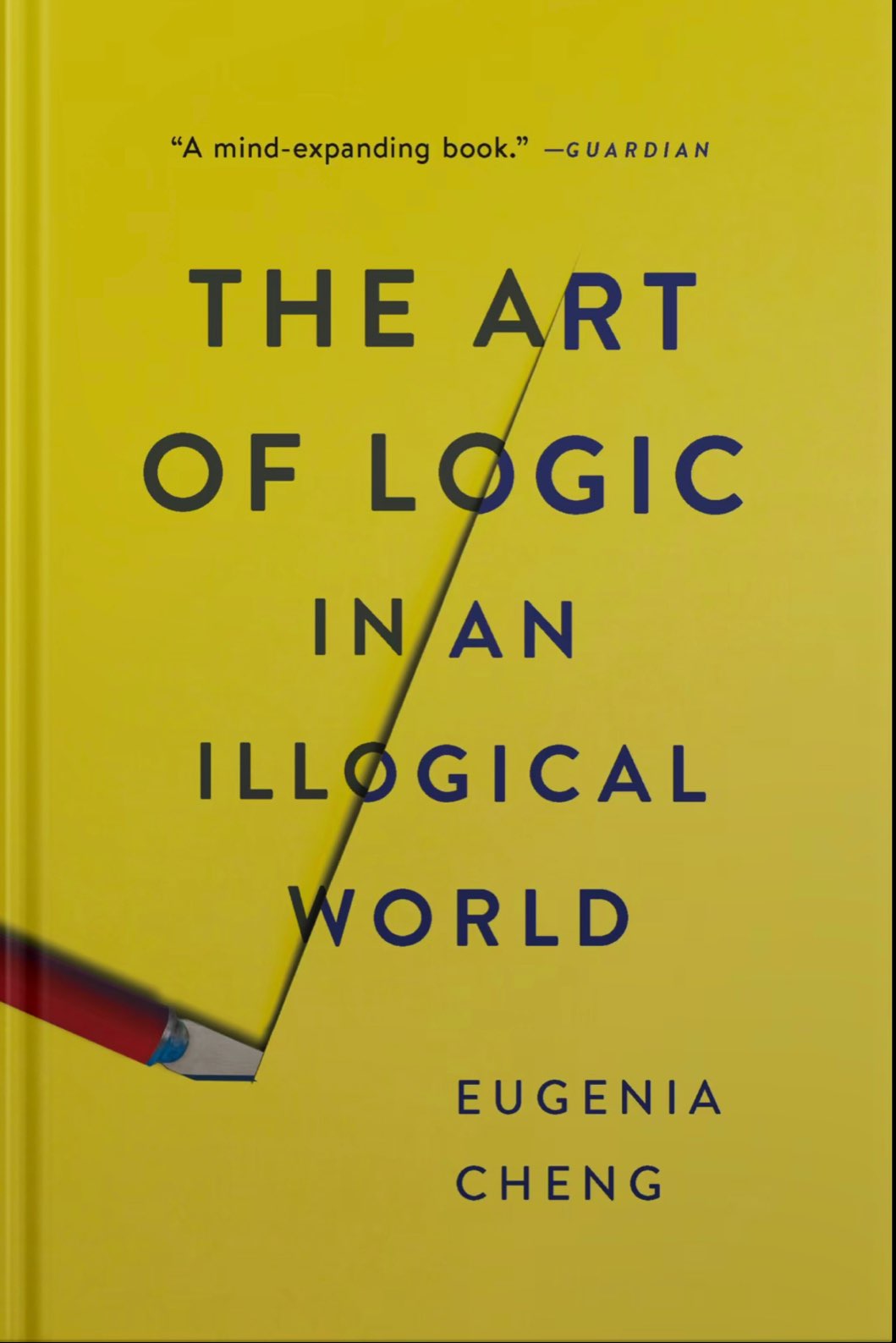
Book Review – The Art of Logic in an Illogical World by Eugenia Chang

I got interested in this book when I saw this in a picture of pile of books a school friend of mine had read thru during his bout of Covid in India. It is an interesting book but I would not suggest it for most people. People who are willing to understand the fallacies of arguments in a heated debate (but really can’t use it to make the other person change his/her mind) might find this interesting. It is like knowing the theory but not being able to put it to practice (or at least much of it).

That said, Eugenia – a British mathematician – does a good job of explaining what is logic, when it works, when it does not work and why it is often not an effective instrument in convincing the other person in a debate.

One quick point she brings upfront in the book is the difference between math and all other subjects. It is the use of logic that enables mathematicians to reach agreements that withstand the test of centuries whereas other subjects – notably science – is continuously refining its points of view.

Math uses logic and science uses evidence. Logical implication means that something is definitely true. Evidence simply means that it contributes to the probability that something is true. To be fair, she does point out that even in math, the whole construct of logic is built upon mutually agreed axioms.

Usually, logic fails due to involvement of emotions, too much data, too little data or too much randomness.

Logic is a great way to verify truth. But that is not the same as convincing others of truth. When we use language, the primary aim of normal language is to simply communicate (as opposed to the primary aim of logical language – which is to remove ambiguity). Verifying and conveying are two different things.

Again, read this is if you try to understand some of the background of why there are so many deeply formed divisive opinions – politics is a prime example today but religion used to be before. It is not going to make you any more effective in trying to change minds though.

Category: Books | LEAVE A COMMENT
2 May 2021

Sunday evening – winding down

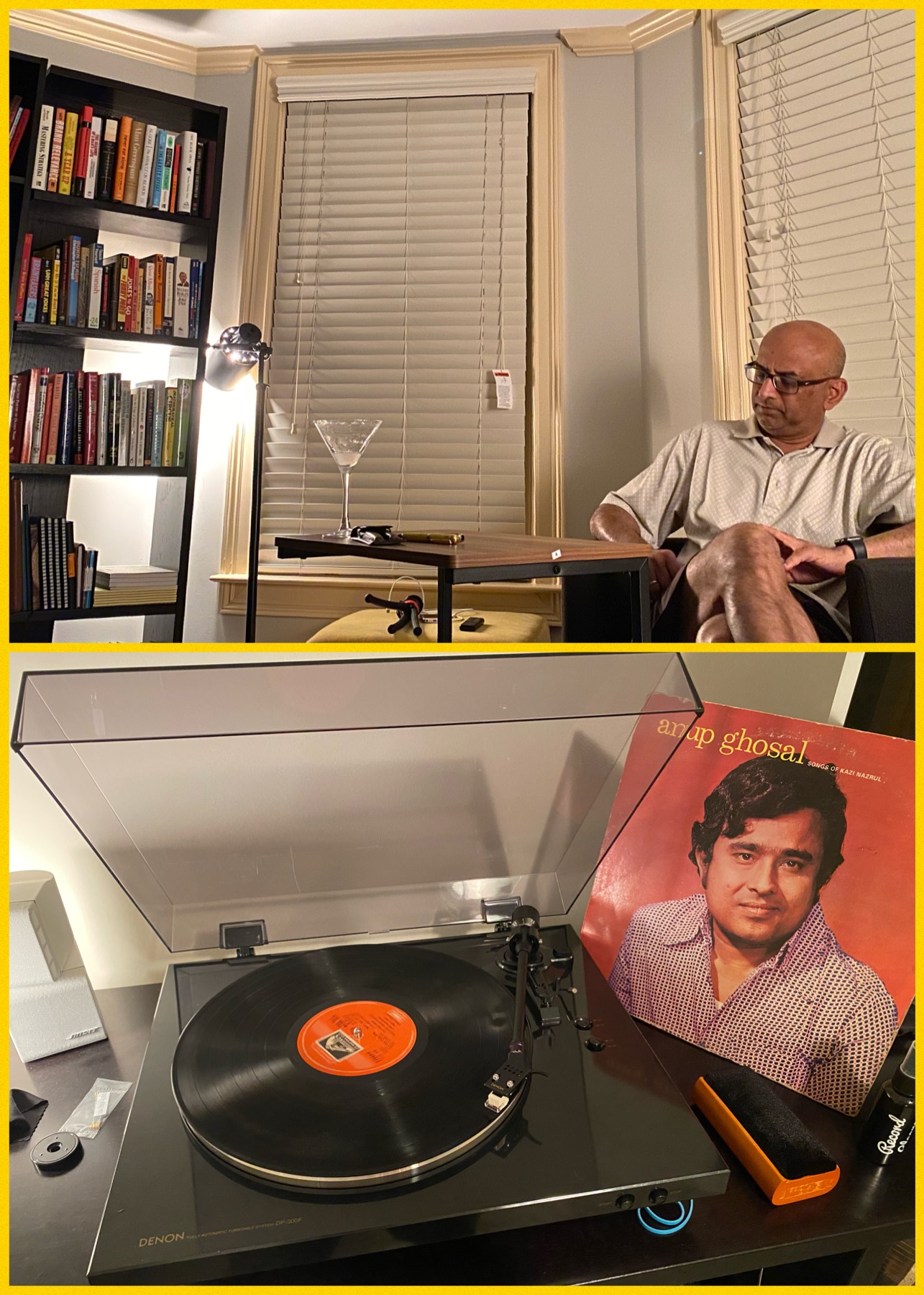
Listening to the other side of the Anup Ghoshal LP record. It has a song special to me – মধুর নুপুর রুমু ঝুমু বাজে…

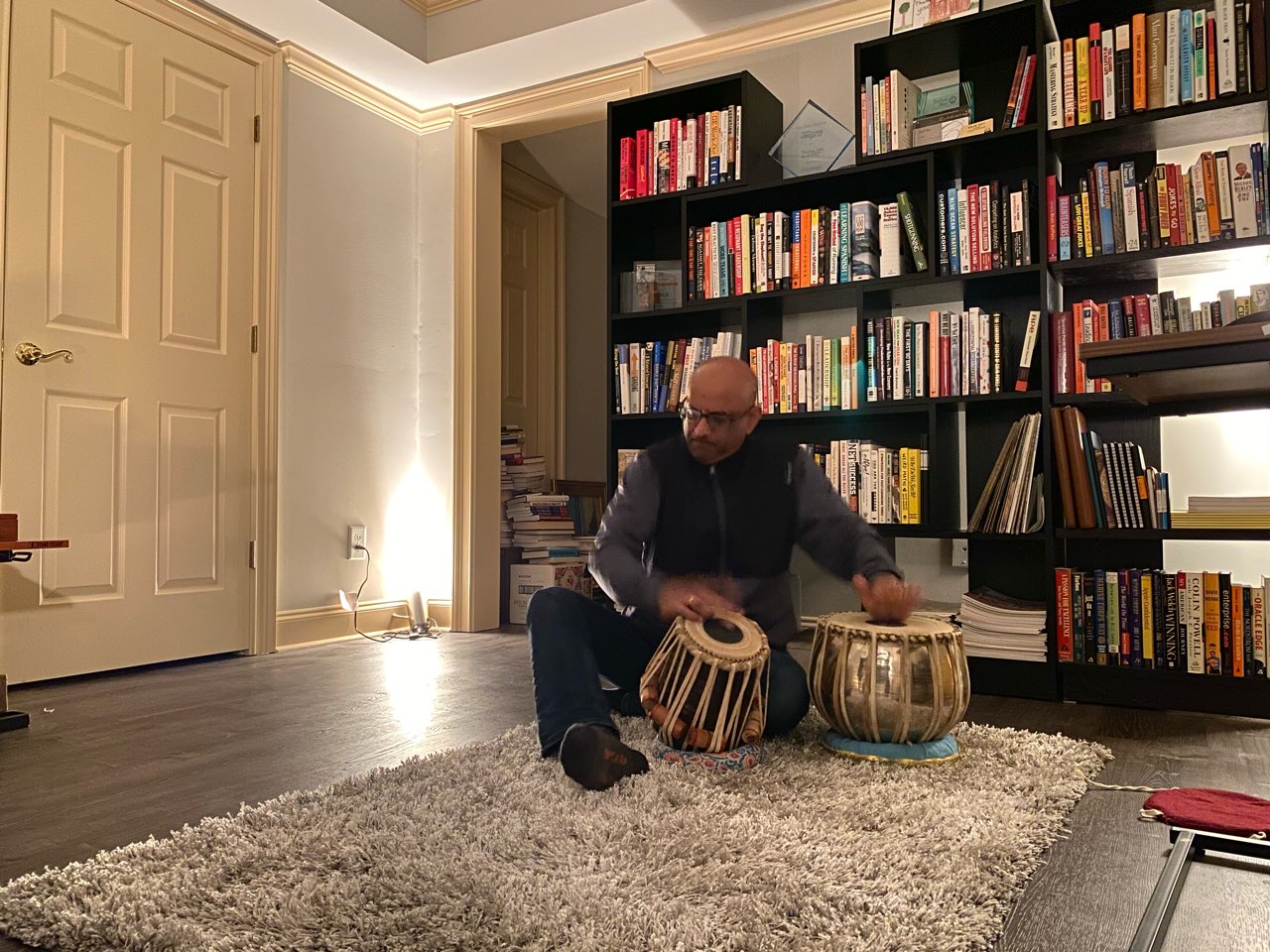
It was the first classical song – or at least the song with Teentaal as the beat on the tabla – that my sister had learnt. Many a practice was done to get back to the “som” correctly…

23 April 2021

This was a favorite song for my mom

Brought out one more vinyl record from the India trip, cleaned it up and listed to it. Nazrulgeeti by Anup Ghoshal. One of the favorite songs for my mom is on Side A – “Nai chiniley amaay tumi”

I think the words go this way…
“Nai chiniley amaay tumi
Roibo aadhek chena
Chaand ki janey kothay fotey
Chaandni raater hena”

Roughly translated…
“So what if I remain a stranger to you
Somebody vaguely familiar to you?
The moon does not know either
Where the fragrant flowers bloom in the moonlit night”

16 April 2021

Mahanayak-er gaan

To my parents, there was none – nor would there be ever – a better actor than Uttam Kumar. The one time they came to the US, Sharmila would get them Uttam Kumar movies from an Indian story nearby and they would spend whole day seeing the same movie over and over again.

Got a vinyl record from Kolkata with some of the songs from their favorite Uttam Kumar movies. Cleaned it up today and listened to it.

The first song was particularly melancholic…

“Boshe aachhi patha cheye
Faguner-o gaan geye
Joto bhabi bhuley jaabo
Mono maaney na”

I sit here awaiting you
Songs of spring humming in my mind
Much as I try to keep you off my mind
The heart defiantly refuses to comply.

21 February 2021

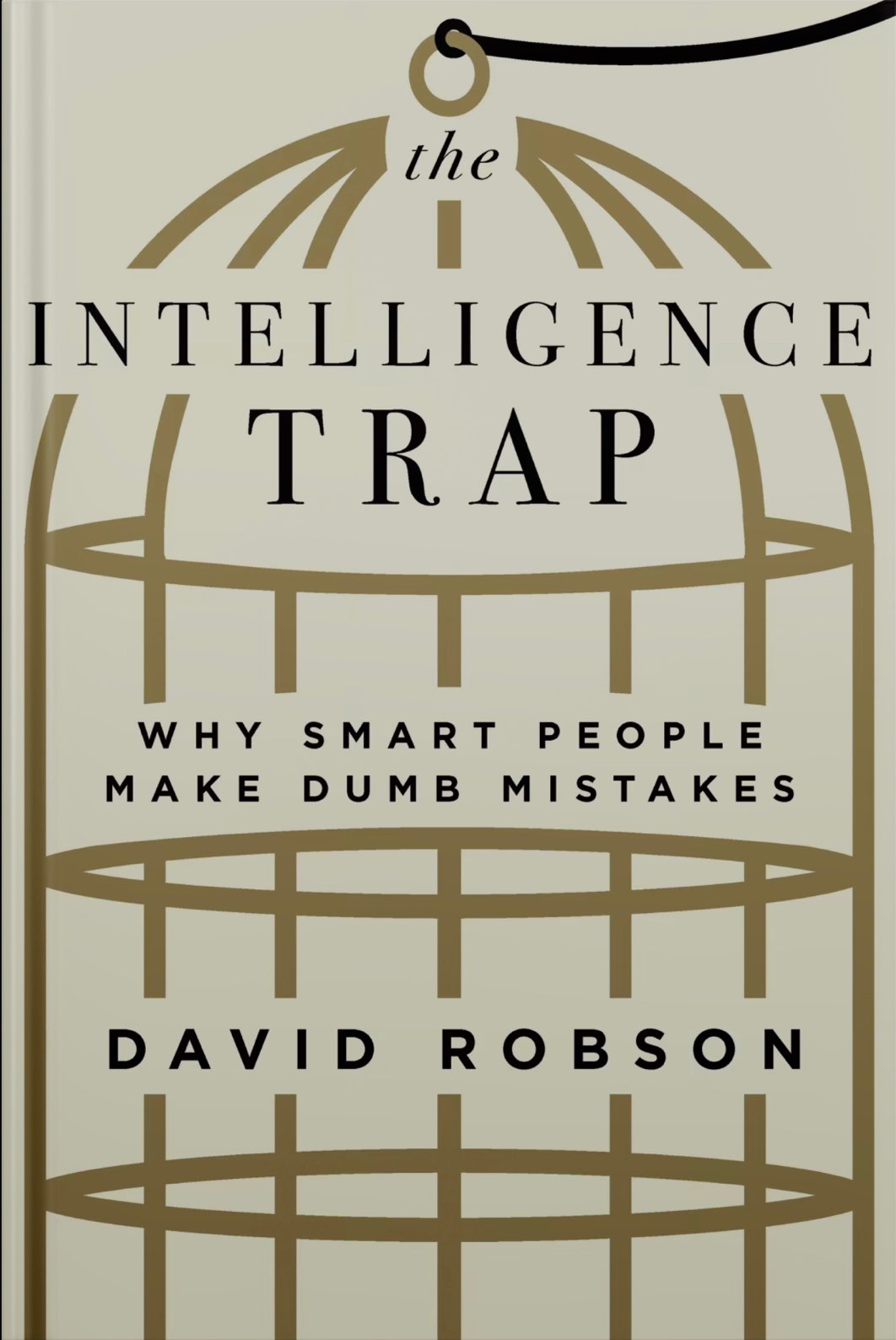
Book Review – The Intelligence Trap by David Robson

The Intelligence Trap – Why smart people make dumb mistakes.

The title itself is enough to pick up the book from a shelf. Once you open it, you cannot keep it down. David’s story telling style (the story on the very first page will get you) and the explanation of research to lay it down to a layman why smart people have such dichotomy of deeply held beliefs – from vaccination to climate to evolution and so on is remarkable.

The book not only explains some of the evolutionary reasons of why and how our biases lead us down these parting ways but also spends quite a few pages explaining how you can try not falling in these traps.

Here are some interesting ideas from the book to pique your interest….

1. Core thesis is when we talk of intelligent people – we reflect on “analytical” intelligence. But judgment requires two other kinds of abilities – “creative intelligence” – ability to invest, imagine and suppose and “practical intelligence” – ability to plan and execute an idea to overcome life’s messy, ill formed problems in a pragmatic way – which needs one to have metacognition (judging your own strength and weakness) and read motives of others (often referred to as social or emotional intelligence)

2. Intelligent and educated people are less likely to learn from their own mistakes, are less able to recognize the flaws in their own logic and when they do err, they build elaborate arguments to justify their reasoning.

3. A great many people think they are thinking when they are merely rearranging their prejudices

4. Academic tests are timed, usually. We are taught that speed of reasoning is a quality of our minds. Hesitation and indecision is undesirable. Being “slow” is stupid. And yet, hesitation, indecision and being slow is exactly what is required to understand one’s own error in judgment.

5. People with high IQs have shown to be equally likely to be in financial distress (miss mortgage payment, bankruptcy, credit card debt) as lower IQ people!!

6. “Myside bias” (confirmation bias) is highest when it speaks to our sense of identity. This explains why we come to very quick decisions (System 1 – or Fast Thinking) when it comes to opinions on religion, politics, nationality or even sports teams! Smart people do not apply their superior intelligence for truth seeking so much as promoting their interests or opinions. Greater education and intelligence simply helps people to justify their beliefs that match their points of views. This explains anti-vaxxers, climate deniers and evolution deniers. They are as intelligent as the other side.

7. Our beliefs are first borne out of emotional needs. Intellect kicks in later to rationalize.

8. Human thought are less about truth seeking. It is about persuading others to our point of view and be skeptical of the other side (most likely from evolution). Thus biased reasoning is not a side effect of increased brainpower – it is the reason for it.

9. “Experts” come with two big challenges – their inability to see the other side (goes against their sense of identity – see above) and others tend to believe them even when what they are saying has nothing to do with with their area of expertise. “The fundamental cause of the trouble is that in the modern world, the stupid are cocksure while the intelligent are full of doubt” – Bertrand Russell. Experts confuse their current level of understanding with their prior peak level of understanding. Therefore, they find it very difficult to to say “I do not know”.

10. Hearing the same opinion from different people has the same ability to convince you as hearing the same opinion from the same person repeatedly!!!