9 March 2014

Few interesting facts about DST – but don’t tell my mom!!

I did not explain all these to my mom today – she would be further confused…
  1. DST is less than 100 years old. (98 in Central Europe and 96 in US)
  2. DST was first proposed by a guy in New Zealand who wanted more daylight to follow his profession – studying insects!!
  3. DST was subsequently proposed by another guy in UK who was frustrated with his back nine game in golf with less sunlight.
  4. Most of the countries scrapped DST after first world war (except a couple in Europe and Canada)
  5. Many adopted them back during second world war and the oil crisis of 70s. US standardized on it only in 1966.
  6. Many have scrapped it ever since!
  7. More inhabited land is covered in this world by countries who have scrapped DST than by those who currently observe it or those who never observed it.
  8. And this is going to completely flummox my mom – in spite of all her confusion, the fact is when she was born, India had Daylight savings. (during second world war when India was under the British). Subsequently it was scrapped. I bet this is a surprise for most of Indian friends too!
7 March 2014

Cool Puzzle

This puzzle does not require math skills but some imagination and visual skills. Assuming you have not seen this problem before, that is. One of the visual skills required is getting past my terrible drawing abilities 🙂
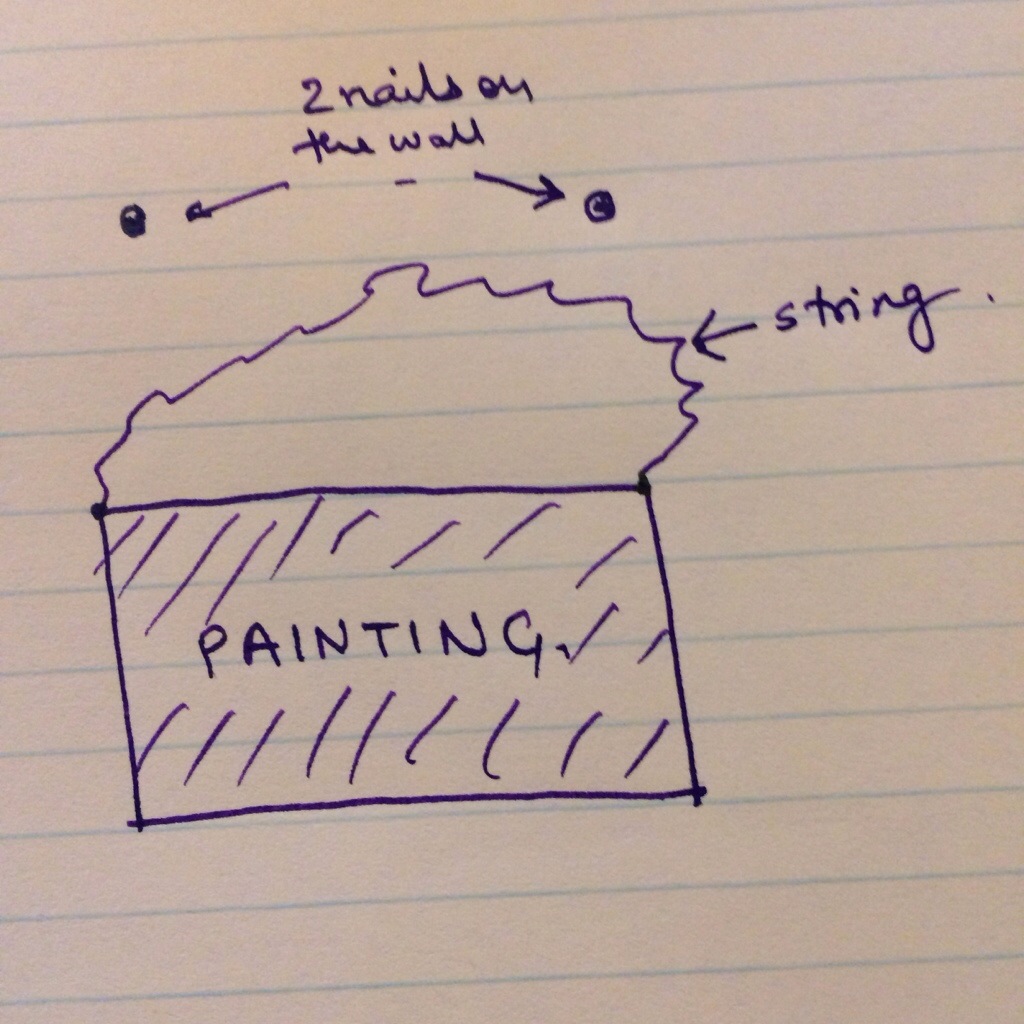
So, there is a painting with a string attached on the top two ends as shown in the picture. And there are two nails on the wall horizontally separated. (the separation distance does not matter).
Can you hang the painting with the string in a way that if any one of the nails come off, the painting will fall down to the ground?
Of course, the painting needs to actually hang from the nails using the string.

20140307-080424.jpg

Category: Puzzles | LEAVE A COMMENT
27 February 2014

New Puzzle

Thursday evening. No flight today. I got done with it on Monday. But still there is a puzzle…

Mary would like to go out with John but John did not care much for Mary. So Mary agreed to play a guessing game with him. John asked her to guess the apartment number that he first lived in. He let her know it was between 8 and 100 (both inclusive). But she had to guess with as few questions as she could.
Her first question was “Was the number more than 50”?
John answered the question. But what Mary did not know is that he lied. (he really did not care to go out with her).
Mary then asked “Is the number divisible by 4?”
John answered that question. But once again, he lied.
Mary thought for a while and asked “Was it a square number”?
This time John answered the question truthfully.
Mary excitedly asked her final question “I know the exact answer if you tell me if the number started with 3 or not”
John answered that question too. But we do not know whether he was telling the truth or not.
At that point, Mary proceeded to guess the apartment number. As you can imagine, she got it wrong. (After all John lied at least twice).
Now, can you tell me what was John’s apartment number?
20 February 2014

Prisoner puzzle.

Thursday morning flight back home from Maryland and New Jersey. Puzzle time!!!

Since last week I was pilloried for lowering my standards of puzzle (once again, I am amazed that people think I have standards), I picked a slightly harder one this week. I heard a variation of this in Car Talk last week as I was taking Tasha somewhere.

If you know this, you will get it immediately. If you had heard this before, it is fun trying to remember the answer. If you have never heard it before, it would be interesting to solve it. Let me know thru FB message if you would like some hints.

As always, do not write on comments section if you have figured it out. This is to give others a chance to solve it. Send me a FB message.

There is a slightly easier version and a slightly tougher version of this puzzle. The puzzle goes roughly like this.

There is a prison with 15 prisoners for life in individual cells with no ability to communicate with each other whatsoever. One day, the warden took all of them out and gave them a chance to go out free. However, there was a catch.

He showed them an isolated room from outside in a separate part of the jail and told them that there were two switches inside. One on the left and the other on the right. The switches were connected to absolutely nothing. They could only be flipped to the on or off position.

The warden, starting the next day, was randomly going to pick a prisoner – at random times (could be few a day or could be none some day) – and take him inside the room. While inside, the prisoner would have to flip any one switch once. (If it is on, he flips it off and vice versa). However, he had to flip one (and only one) switch. He could choose which one to flip, of course.

Slightly easier version: The warden told them that both the switches were initially in off position.

Slightly more difficult version: The warden told them that nobody – including himself – knew what the starting positions of the switches were.

And then the warden said – “I need somebody among you – I don’t care who – some day – I don’t care when – to come and tell me that you are confident that all the prisoners have visited the room at least once. If that person is right, all of you go scott free. If not, all of you will be put to death.”

He gave them sometime to get together that day to devise a strategy to see if they could come up with a foolproof plan to get out.

Can you suggest a strategy (for both the easier and more difficult case)?

Remember, they don’t need to tell immediately after all of them have visited once. They just need to be absolutely sure that each one of them has visited the room at least once.
30 January 2014

Puzzle time: False positives

This week’s trip is over. Time to leave Florida and start skidding on icy Atlanta roads. Also time for a puzzle.

Many of you are aware that my current job involves catching fraud in online transactions. We of course focus on building systems that can catch maximum amount of fraudulent transactions. However, what you may not know is that an equal challenge in building these systems is making sure that we do not flag the good transactions as fraudulent (and irritate the good customers). This is always a tough balance. This is also called the “false positive” problem. (The test showed “positive” but that is a false result).

Here is a false positive puzzle. A village has only one lab that can perform a particular test for a particular disease. The test, however, is only 98% accurate. So, a patient who does not have the disease will get “you do not have the disease” report 98% time. 2% of the time, it will say (erroneously) say “you have the disease”. Similarly, a patient who indeed is suffering from the disease, will get a “you have a problem” report 98% of the time. The rest 2% time he or she will get a clean chit erroneously.

You also know that 0.5% of the village population has been indeed afflicted by the disease.

Your friend from the village just received a report that he has the disease.

How concerned should he be? What is the real probability that he has the disease?

21 January 2014

Puzzle: 16 coins

I found this puzzle today. I have not tried it myself. But I think you will know when you get the right answer. Further, unlike other times, I am writing this to you on my way out of Atlanta as I commence my business trip, not on my return trip. Which means, I may not be able to check answers till the end of day or in flights…
Do send personal messages only and not comments.

Arrange 16 coins in a simple square of 4 coins by 4 coins. Now, remove 6 coins in a way that every row and every column still has even number of coins left.

18 December 2013

Birthday puzzle

A few days back, I called up an old friend Anamika to wish her happy birthday and she told me that she was out having lunch with her neighbor who also has the exact same birthday!! That got me thinking about what is the probability of such a coincidence happening. Here is a puzzle from that thought process.

If you are mathematically oriented, try solving it. If not, take a guess and see how it compares with the right answer. My guess is that the guess is going to be much larger than the actual number.

Simply put, what is the minimum size of a class where the probability that there is at least one birthday that is shared by two students is more than 50%?

Put in details, if you have two students in a class, the chance they will have the exact some birthday is 1/365. If a third student comes in, there is a higher probability of two of them having the same birthday. If a fourth student comes in, the probability increases further. At what size of the class do you have a 50-50 chance of a birthday being repeated?

13 December 2013

Some interesting trivia puzzles…

Napoleon was not as short as he is made out to be. In fact at 5′ 6.5″, he taller than an average Frenchman. So, where did the misconception of he being short come from?

This is for my American football fans. In the very first Super Bowl, at the start of second half, Packers had to kick off the ball twice to start the game. Do you know why?

What is the longest English word that does not repeat a letter?

Once before, we had talked about English words which have all the vowels in the proper sequence – e.g. Abstemious. Now can you come up with words that have the vowels in the reverse order? (First u, then o….)

The phrase “two plus eleven” and “one plus twelve” are interesting in that both give “thirteen”. They have another relationship. Can you find out what?

There is a debate on whether “I am” or “Go” is the shortest English sentence. It depends upon whether you believe you have to have a subject stated in a statement. Do you know what is the longest sentence in English language?
I will give you the answer – “Marriage” 😉
Okay, that was not a trivia puzzle. Try the other ones….