16 June 2015

Real life puzzle from Italy

Here is an interesting puzzle that we faced in real life a few days back. We had come back after a beautiful day in Verona and finally we were all ready to retire. Next day we had to leave for Rome early in the morning and that posed a logisitics issue. We had four rooms in our resort – one for our daughters, one for Sunil’s sons and one each for the set of parents. Now the resort we stayed in gave us only one door keycard for every room. Once you entered the room, you had to put in the keycard in a slot next to the door and that triggered the power in the room. Without this, the lights and AC wouldn’t work.

The issue was that while the adults were ready to sleep a little after midnight and wake up early, the kids were notorious for sleeping much later and showing no signs of getting up till 10 am. No amount of knocking on the heavy doors had helped in the past.

The puzzle was how to wake up the kids early next morning. We needed to enter the room. But the keycard was required to be inside – else the power would not work. Thus we could not possibly enter the room.

So, as a first shot, I yanked out the key from the power slot and put in a paper card of the same size. That would not work. I put in a credit card. That would not work either. (If it actually worked, obviosuly, the parents would keep their kids’ room keys with them and use them to enter the kids’ rooms next morning and wake them up). Later I found out from the resort folks that indeed only a hotel card would work for the slots. Apparently the hotel cards had a chip inside (not the magnetic strip) – which is what they programmed when they gave us the keycard. The door cared about the room coding. The slot reader however, did not care how the chip was programmed – it just needed to detect a chip in the card at the right place.

We were way too lazy to come out of the building and walk up across the resort to the lobby to pick up extra cards.

BTW, Sunil had a bright idea that let one parent sleep with one kid that night – which would have worked, but the kids immediately voted the idea down. But we did find an elegant solution.

Can you solve it?

22 May 2015

Puzzle time in India !

Today was the last evening in Kalyani this trip. Like everyday, after dinner, we all went for a walk. “All” means the nephews, niece, my brother, sister, brother in law and of course myself. We, the adults, chat about a lot of things and I usually give the kids some math or logic puzzle to keep them busy.

Today started as an innocuous puzzle. But the adults joined in too. As a result, we amped up the difficulty of the puzzle. We have not been able to solve it fully. Maybe you can…

The puzzle is simple – using just the digits 1, 2 and 3 (each only once) derive all numbers from 0 to 25. You can use any of the following mathematical symbols any number of times : plus, minus, multiplied by, divided by, factorial, square root of, decimal point and parentheses (+ – * / ! Sqrt . and () ). For the programming types, ++ and — are not mathematical symbols.

E.g you can get 7 by 21/3 or 3*2+1 etc etc

We got everything other than 19 and 21. Still stuck.

Care to give it a try?

I am going to sleep now – will check tomorrow morning. Feel free to answer in Comments section.

12 May 2015

Different kind of Puzzle – more of a trivia question

I took this grainy picture as I was driving last evening. It was very cloudy and the picture is not the best. But here is a question. There is something unique about the flag that you see. Can you guess what it is?

I will give you two hints – Look at the relative size of the car on the highway. And the other hint is I was in Wisconsin last evening.

image

6 May 2015

Puzzle – numerical one this time

This week I was with Arijit and he mentioned that he had not seen me posting puzzles in some time. And that is true. I had not received much answers or attempts for the last few ones. I figured nobody was interested. Let’s see how this one does. This is dedicated to Arijit.

Send me answers as personal messages on FB  instead of comments.

Can you come up with a ten digit number where the first digit is also the count of 1s in the full number, the sound digit is also the count of 2s, the third digit is also the count of 3s and so on and finally the tenth digit is the number of 0s in the number.

Three years and two months back, I had posted a variation of this problem.

3 March 2015

Starting Tuesday with a puzzle and an early morning flight…

There is a box with 99 white balls and 101 black balls in it. And you have a lot of white and black balls outside the box. 

You pick two balls at random from the box. If they are a black and a white, you throw the black ball out and put the white ball back in the box. If however, you got two whites or two blacks then you throw both of them out and instead put back a black one from the pile outside.

Now, you keep doing this till you have one ball left in the box.

What color is the ball?

26 February 2015

Whoa! What the heck happened?

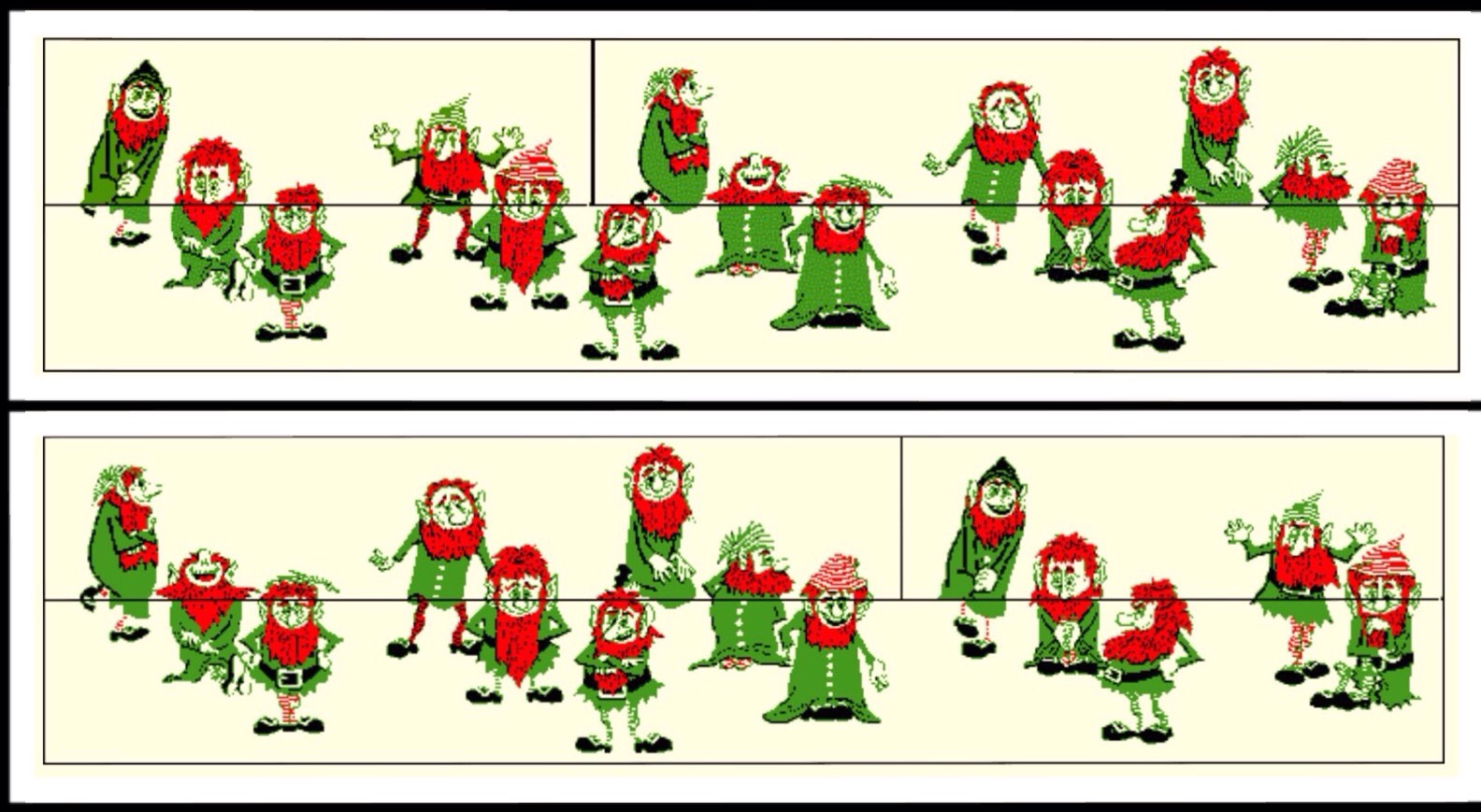
This will knock your socks off. I found this on the internet.

Look at the picture on the top. If you do not believe the rest of the puzzle, take a printout on your printer. Now divide the picture horizontally as the line in the middle shows. Look at the top half. Divide it into two parts as the vertical line shows.

Now exchange the position of the two parts on the top. Keep the lower half as is. You get the picture in the bottom portion.

If you do not believe me, carefully check that the bottom half is exactly the same in both pictures and the top right is exactly the same in the top picture as the top left in the bottom picture and vice versa.

So far so good? Count the number of people in the top picture ….15, right?

Now count the number of people in the bottom picture!

Let me repeat the subject line…

Whoa! What the heck happened? 🙂

(null)

6 February 2015

Chessboard puzzle

Here is a simple or complex – depending upon your perspective – puzzle. It is complex if you try to enumerate all possibilities. There is a very simple and elegant way though.

As always, if you are reading this on FB, do not post your answer on Comments section. Sent me a message.

Question: In a simple 8 by 8 chessboard, how many rectangles are there?

As you can imagine a rectangle can be one square by one square – and there are 64 of them – (squares are rectangles) or two squares by one square (and there are quite a few of them) or three squares by five squares and such….

30 January 2015

Puzzle from India

I was enroute from India to USA when I got a call from one of my nephews with the following math problem he was stuck with. I am posting that as the puzzle of this week.

There is a jar with 50 pieces of paper written “1” thru “50” in them. You pick 5 of them at random and lay them out in increasing sequence. What is the probability that the middle number is 30?

1 January 2015

So, that is how I spent my first hours of the New Year!!

I was wondering how to start the year. Figured, let’s do something different.
So, I sat down with the last puzzle I had given and after two hours of putting pen to the paper, finally solved the probability problem. Whew!!! hopefully that would be some mental exercise for the little of whatever remains of the grey cells. Here is the answer…..

(BTW, anybody who cares to actually go thru the solution, please let me know if I have made any calculation errors. I am sure about the logic. And I have double checked the LCMs, GCMs and all that… just in case, I still made a silly mistake, point it out please)

The three people A,B,C get a random sequence, of which there can be 6. Let’s look at those 6 cases one by one.

CASE 1. Sequence: ABC.
Note that A, who goes first, would ether shoot B or C (random). If he shoots B, B is dead (since A is a sure shot). Prob of B surviving is 0. C then shoots at A. Chance of A being shot is 1/2 which means C survives. But if C misses (prob 1/2), A will for sure shoot him in his chance next. So, A, B and C prob are 1/2, 0, 1/2

If A shoots at C, C is dead, B then shoots at A. Prob of A surviving is 1/5 (since B is 80% accurate) but after that A will, for sure, kill B. So, the prob of A, B and C surviving are 1/5, 4/5, 0

Since the target for A is chosen in random, both the cases are equally likely. Therefore weighting the prob equally between the two events, the Case 1 prob for A, B and C surviving are 7/20, 2/5, 1/4. [7/20 equals half of 1/2 plus half of 1/5 etc etc etc)

CASE 2. Sequence: ACB.
You will note that this is same as Case 1. A either shoots B dead first and C shoots at A or A shoots C dead first and then B shoots at A. If A survives in either case, he finishes off C or B as the case might be. Exact situation as above. So the prob for A, B and C are 7/20, 2/5, 1/4.

Before I go to next cases, let us look at the pattern where A is dead (unlike the above case). So we have B and C and one of them will go first.

PATTERN X:
B and C are there alive and B shoots first. The prob of B surviving is when
(*) B shoots C dead with first shot – 4/5 OR
(*) B misses (1/5), but then C misses too (1/2) and then in the second chance, B succeeds (4/5) OR
(*) the same sequence as before except in the last step B misses (1/5) and then again C misses (1/2) and in the third chance B succeeds (4/5) and so on.
That prob would be 4/5 + 1/5×1/2×4/5 + 1/5×1/2×1/5×1/2×4/5 + …. which equals to (4/5) x (1+1/10 + 1/100+…) which equasl to (4/5) x 1.11111… which equals to 0.888888… which is 8/9. So B is 8/9 and C is 1/9.

PATTERN Y:
B and C are there alive but this time C shoots first. The prob of C surviving is when
(*) C succeeds with first shot (1/2) OR
(*) C misses (1/2) but then B also misses (1/5) and then C succeeds in second shot (1/2) OR
(*) same sequence as above except join the last step C misses (1/2) and then B misses again (1/5) and C succeeds in the now third shot (1/2).
That prob would work out to be 1/2 + 1/2×1/5×1/2 + 1/2*1/5*1/2*1/5*1/2+….. which is equal to (1/2) x (1 + 1/10 + 1/100 +…) which is equal to 1/2 x 1.1111… which is equal to 0.55555… which is 5/9. So B and C’s prob are 4/9 and 5/9

Let’s get back to our original cases.

CASE 3. Sequence: BAC.
B can shoot at A first. If he misses (1/5), then now it becomes ABC which is CASE 1. So A, B, C prob are 1/5 of CASE 1 which is 7/100, 2/25 and 1/20.
If however, he did kill A (4/5) now it is he and C left, which C going first – in other words, PATTERN Y. Multiplying PATTERN Y by 4/5, now we have A, B and C as 0, 16/45 and 4/9.
Adding these two cases, we get A, B and C as 7/100, 98/225 and 89/180

Or, B could have shot at C. If he did succeed (4/5), next A is going to shoot him dead. So the prob of surviving (after factoring is the 4/5 prob) are 4/5, 0, 0.
But if he failed in shooting C (1/5), now we have CASE 2!!! Therefore the prob are (1/5 of CASE 2) = 7/100, 2/25 and 1/20.
Adding the above two, we have 87/100, 2/25 and 1/20.

Since B would have picked A or C in random, the probability for CASE 3 is the average of the above two which would work out to be 47/100, 58/225, 49/180

CASE 4. Sequence BCA
I will come to this case later.

CASE 5. Sequence CAB
If C shoots at A then it could either be he succeeds (1/2) and then we have PATTERN X. Thus prob = 1/2 of (0, 8/9 and 1/9) = 0, 4/9 and 1/18
or C could have missed A (1/2) and then we have CASE 1!! Thus prob would be 7/40, 1/5 and 1/8.
Adding the above two, we have 7/40, 29/45 and 13/72

Or, if C shot at B first then it could have been that he either succeeded (1/2) in which case A would kill him next making the prob of A, B and C being 1/2, 0, 0
If C missed (1/2) then we again have CASE 1. Thus as calculated before, the prob are 7/40, 1/5 and 1/8.
Adding the above two, we have 27/40, 1/5 and 1/8.

Since C would have picked A or B in random, we weigh the above two cases equally and now have this Case prob as 17/40, 19/45 and 11/72.

CASE 6. Sequence CBA
If C shoots at B first and succeeds (1/2), A will shoot him dead for sure next. Thus we have the prob as 1/2, 0, and 0
If C however missed B (1/2), we have CASE 3!!!. That would be 1/2 of CASE 3 which is 47/200, 29/225 and 49/360
Combined, the prob are 147/200, 29/225 and 49/360

On the other hand, if C shot at A first,
If C succeeded (1/2), then we have PATTERN X which means the prob is 1/2 of PATTERN X making it 0, 4/9 and 1/18
If C however failed (1/2), we have now CASE 3!! Thus the prob would be 47/200, 29/225 and 49/360
Combined, the prob are 47/200, 129/225 and 69/360

Since C would have picked A or B at random, we average the above two to get the rolling prob: 97/200, 79/225 and 59/360

Now let’s go back to
CASE 4. Sequence BCA
If B shoots at A first and succeeds (4/5), we have PATTERN Y. Prob then is 0, 16/45 and 4/9
But if B failed in killing A (1/5), then we have CASE 5!! Prob then is 1/5 of CASE 5 which is 17/200, 19/225 and 11/360
Together that would be 17/200, 99/225 and 171/360

If B shoots at C first and succeeds (4/5), then next A will for sure kill him making the prob 4/5, 0, 0
But if B failed in shooting C dead (1/5), we have CASE 5 again! Prob, as above is 17/200, 19/225 and 11/360
Together that would be 177/200, 19/225 and 11/360

Since whether B shot at A first or C first was random, averaging the above two, we get the CASE 4 prob as 97/200, 59/225 and 91/360

So finally (phew) we have the following:

Sequence and prob of A or B or C surviving as:

ABC: 7/20, 2/5, 1/4
ACB: 7/20, 2/5, 1/4
BAC: 47/100, 58/225, 49/180
BCA: 97/200, 59/225, 91/360
CAB: 17/40, 19/45, 11/72
CBA: 97/200, 79/225, 59/360

Since that above are all equally likely, we finally take the average of those six cases to get to the final answer of A, B and C as: 513/1200 , 471/1350 and 483/2160 !!

Phew!!! Ok! Now I am ready for the New Year.

Category: Puzzles | LEAVE A COMMENT
29 December 2014

Probability Puzzle

This is an interesting probability problem. There are multiple variations of this. I am presenting a simple version.

There are three persons A, B and C who are aiming to settle a dispute the old dueling style except there are three of them. Here are the rules..

a. At random, it is decided what will be the sequence in which they will fire
b. When a person’s chance comes, that person is given at random the target (one of the other two) to shoot at
c. A is a sure shot (100% chance he will shoot the person dead), B is less so – has 80% chance of succeeding and C is a neophyte – 50-50 chance that he will succeed with a shot.
d. They keep on with this sequence of shooting till one man is left.
e. There are no other extraneous conditions – e.g. no stray bullets etc etc.
f. What are the probabilities of A, B and C surviving?