20 January
2024

27 September
2023
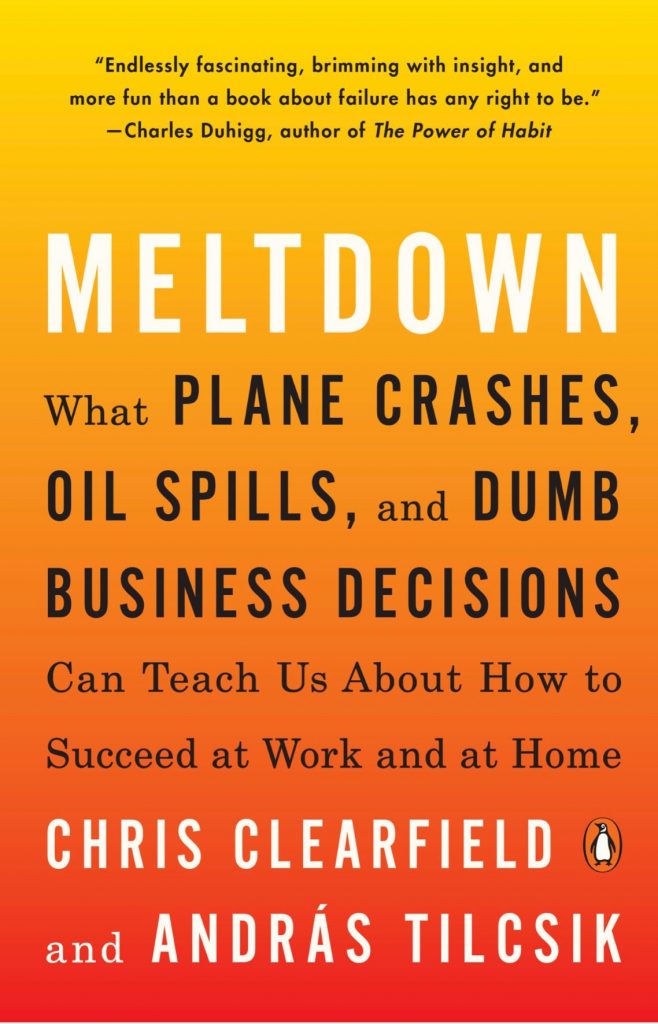
Book Review: Meltdown
by: Chris Clearfield and Andras Tilcsik
I got to know about this book from the Bookclub group in our office. I was actually reading a different book. But the synopsis looked interesting enough that I paused on the other book and started reading this.
This book deals with catastrophic failures like the blowing up of Challenger, or the Deep Horizon blowout or the wrong movie announced as the winner at the Oscars … and tries to find out what are the common traits and how to avoid potential such failures in the future.
The key take away is to realize that a system needs to have two different traits to give rise to catastrophic failures. One is that the system has to be “complex”. By that it does not necessarily mean scale – but systems where their parts are more likely to interact in hidden and unexpected ways. When something goes wrong – multitude components fail and it is difficult to understand the root cause.
The other aspect is “tight coupling”. Loose coupling means there is enough slack that if one component fails, others won’t cascade. Tight means if one fails – others will start failing too. And it cannot be stopped. Ironically, safety systems are the biggest single source of catastrophic failure in complex, tightly coupled systems.
In wicked systems – not much feedback – (as opposed to kind systems – frequent feedback), this becomes even more problematic.
Couple of tricks the authors suggest include:
(*) Subject Probability Interval Estimates: instead of predicting yes or no or 99% vs 1%, predict at different intervals.
(*) Premortem – assume things have gone wrong. Now look back and predict what might have been the reasons
A quote I liked a lot: “We construct an expected world because we can’t handle the complexity of the present one, and then process the information that fits the expected world, and find reasons to exclude the information that might contradict it. Unexpected or unlikely interactions are ignored when we make our construction.”
Some watch outs that are good pointers to corporate leaders too:
More often than not, we don’t take into account how luck is often the reason systems have not broken down. We take that as a reason to believe the system is fine. (outcome bias)
Support dissenting opinions by speaking the last as a leader.
Our tendency for conformity can literally change what we see. Diversity in a team feels less familiar and feels less comfortable. There might be discomfort, but we tend to be more objective and are less likely to go along.
Homogeneous groups create comfortable feeling of familiarity. This unfortunately leads to doing less well in complex situations AND feeling confident about the same wrong decisions.
Some other interesting things: The most frequently used diversity programs didn’t increase diversity. In fact, they made firms less diverse. Voluntary diversity training is what yielded results. Managers need to feel it was their decision to participate.
Anyways, it is a very good read. Anybody will find some aha! moments from life and work in this.
18 May
2023
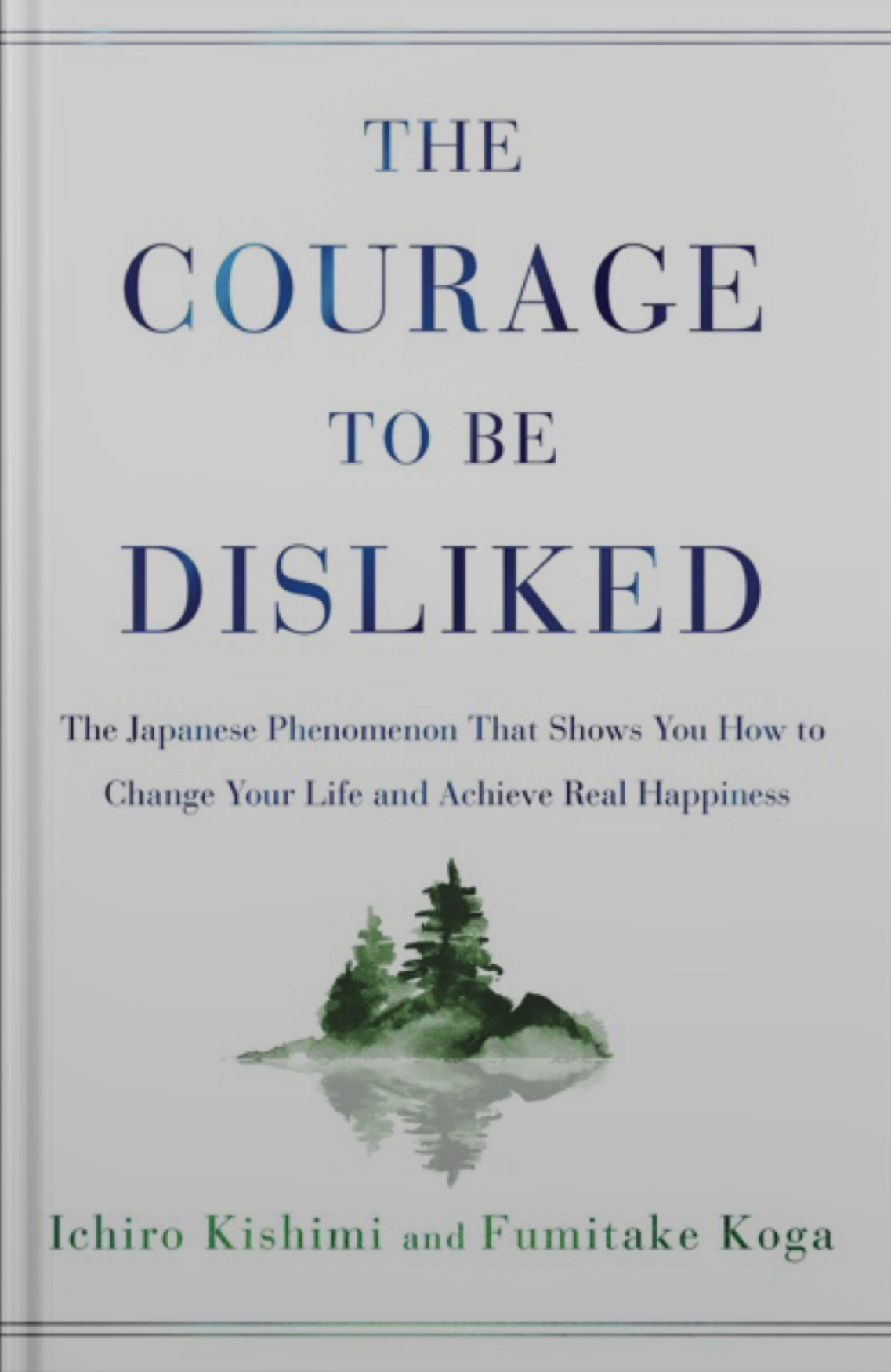
Book Review: The Courage to be Disliked
by: Ichiro Kishimi and Fumitake Koga
I got to know about this book from a quote that my friend Roger Whitney had sent me.
This book is written as a conversation between the “Philosopher” and a young student (“Youth”). I assume it was written in this format to make it more readable and verbalize thru the questions of the Youth, the questions a reader might have. This format, however, did not land well with me. For one thing, I did not really have as many questions as the youth and therefore, the reading was a bit jerky. I would have rather read a normal essay style.
That said, one can learn a lot about Adlerian philosophy. And this is what Roger’s quote was all about.
A few things you might learn about Adlerian philosophy
1. It takes the approach that the past does not matter. This would go against other philosophers like Freud who believed that our current behavior is because of what has happened in the past – called etiology. Adler argues that our behavior is entirely governed by what we want in the future (teleology).
2. All problems are interpersonal relationship problems. Feelings of inferiority are subjective assumptions based on our own comparison with others. On this one, the authors give a nice counterexample of short people. Such values, Adler argues are based on social context. Thus it is really a choice we make. Adler has an interesting way of putting things – Humans are all equal. But not the same.
3. There is an interesting trick Alder goes into – “Discard other people’s task”. Basically, it goes into you do what you need to do. If something is not your task to do, do not worry or think about it. This means not only not seeking recognition but this also means do not fret about what your child is not doing even after you have reminded them. That is their task to do. Worrying will only make you unhappy on something you cannot control. This part of the book does a good job on how to reconcile this with what would therefore then be good parenting exercises.
4. The following quote appealed to me – “Unless one is unconcerned by other people’s judgments, has no fear of being disliked by other people, and pays the cost that one might never be recognized, one will never be able to follow through in one’s own way of living. The courage to be happy is also the courage to be disliked.”
5. In Adlerian philosophy, a sense of belonging is something that one can attain only by making an active commitment to the community of one’s own accord and not simply by being there.
6. In another interesting concept, Adler says “Do not praise”. In the act of praise, there is the aspect of it being “the passing of judgment by a person of ability on a person of no ability”. Instead of praise or rebuke, there should be active “encouragement” that can only come from a horizontal relationship.
7. Adler defines happiness as the feeling of contribution.
8. And finally, Adler believes that life, in of itself, has no meaning. Whatever meaning life has must be assigned to it by the individual.
27 December
2022
Red Rackham’s Treasure
Tintin is not a comic book that is very common in the USA. Although, Steven Spielberg did make a movie out of it. In India (or for that matter, anywhere in Europe too), Tintin was part and parcel of growing up.
The protagonist was ably supported by the warm-at-heart (a big part of the heart warmed by his penchant for whiskey) Captain Haddock (of the “ten thousand thundering typhoons” fame), the well meaning, hard of hearing but brilliant scientist Cuthbert Calculus (with his pendulum and “westwards, westwards” refrain), the bumbling twin detectives Thomson and Thompson (“to be precise, with a “p” as in psychology and without a “p” as in Venezuela” is the way they would clarify) and of course the ever faithful dog Snowy.
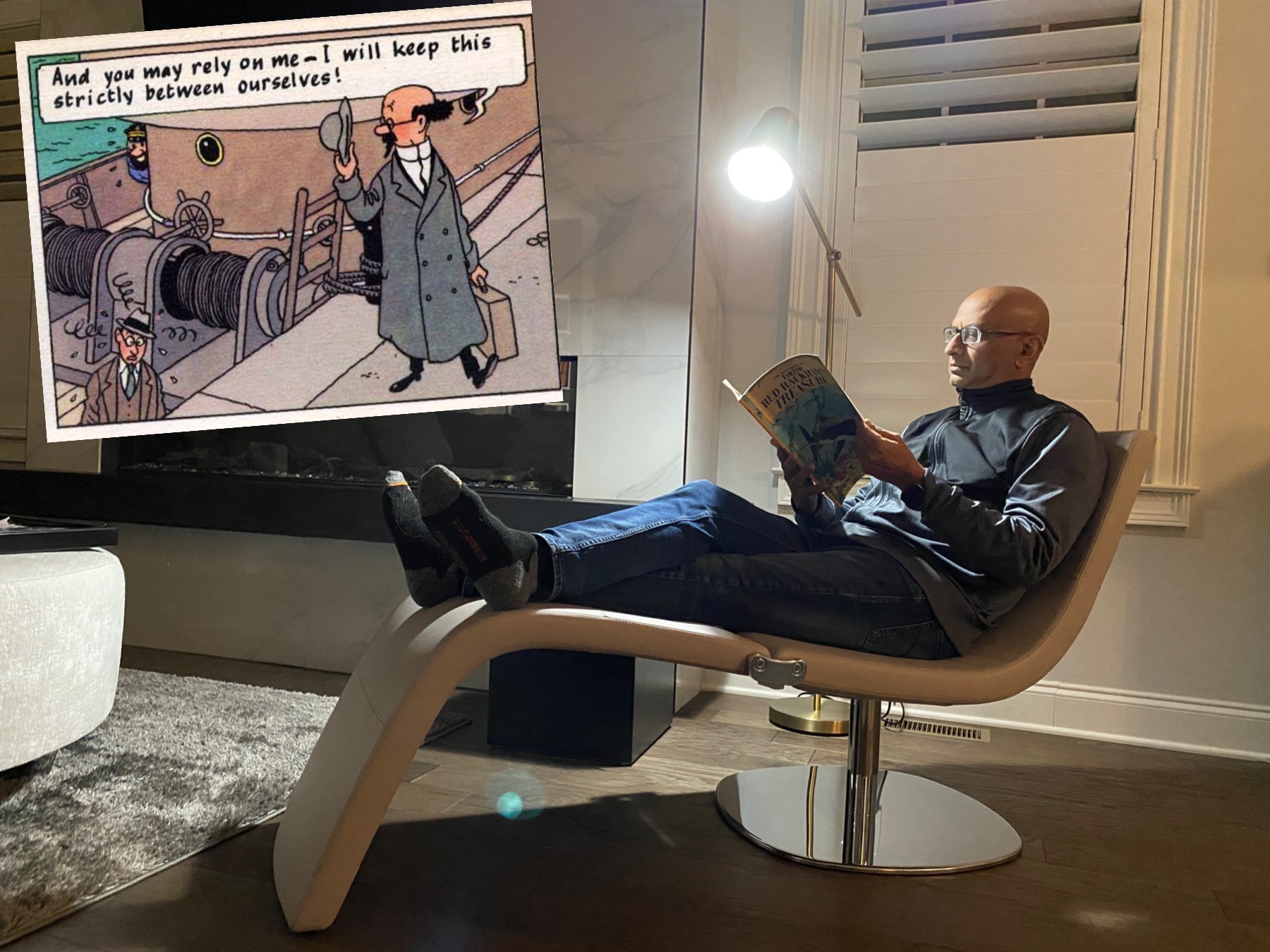
With Natasha back in her home and Nikita out with her friends, Sharmila pulled up a book to relax in the evening. And I pulled out the “Red Rackham’s Treasure”.
You would think that after 45 years or so, I would not find it as interesting. But you would be wrong. That is the brilliance, I sense, of the Belgian cartoonist Georges Remi.
While as a child I focused on the story line, these days, at my age, I focus a little more on the creation itself – how the cartoonist is telling and drawing the story.
One of my favorite pictures is the one in the inset. The quick background is this: Before our favorite team would go out on a treasure hunt, the story was leaked in the Daily Reporter. Which infuriated them no end and caused a great deal of inconvenience.
When they came back, the same reporter accosted them with all sorts of questions. Captain, taken by surprise, was livid to see the reporter again. But on second thoughts, he came up with a cunning idea. He introduced Calculus as his secretary and let him take the interview. If you remember, Calculus was very hard of hearing. So the conversation – if you can call that, more like two independent monologues – that ensued is hilarious. The ever increasingly agitated reporter would ask one more pertinent question. And Calculus would invariably answer a completely different question with absolutely no bearing to the real context, whatsoever.
The end of it is seen in the inset. Calculus walks away very satisfied with the interview. The journalist was left in a complete tizzy. But the best part is the smug, mischievous smile on the impish Captain’s face all the while listening to the conversation peeking from around the corner. You can almost see him chafing his palms!!
That was a good read!!
17 December
2022
Book Review: Are you thinking clearly?
Written by two journalists – Miriam Frankel and Matt Warren – this book will intrigue you if you care to understand how poorly we all think. The self-conviction we have about how clearly we think (albeit with some humility that we might be wrong at the edges) could not be more misplaced.
The authors fairly comprehensively cover the various variables that often cloud our thinking – yes, simply feeling hungry (or hangry as the authors say), make people make very different decisions. This has been proven by multiple researches.
It gets into how your thinking is influenced by what you eat (thru the gut), what language was your first language that you learnt, simple marketing tricks… about 29 such factors.
In the end, you will realize that you are not one uniform identity that thinks and makes decisions consistently. Far from it. We are all social beings that change our thinking or decision based on who we are with. Or who we were with.
I have to admit that while reading the book chapter by chapter, I found no “flow”. It was like moving from one independent variable that affects your thinking to the next one in a very disjointed way.
But in the end, you realize that – that is the exact point the authors are trying to make. Our thinking is not a smooth one – it gets affected by different variables and circumstances at different times. At least this helps you understand what is likely making our thinking murky even if we do not realize that.
I think the following excerpt from the book sums it up well…
“Despite what countless other books will tell you, positivity and optimism come with plenty of pitfalls – not least that they can make you overconfident, blinkered and gullible – and the relentless pursuit of happiness will likely only make you miserable. Nor is a high IQ the foolproof solution it is claimed to be – it doesn’t make us immune to bias, prejudice or mental illness, and it won’t automatically make us challenge our own thinking. To make the most of our intelligence, we also need intellectual openness, flexibility and conscientiousness as well as emotional stability and intelligence. And if you believe love will clear your head, think again. We all know how muddled and mindless that can make us.”
6 November
2022
Book Review: “Humor, Seriously”
Authors: Jennifer Acker and Naomi Bagdonas
This is a book that I am totally schizophrenic about. I have no recollection about how I found this book. But I know it was not available at iBooks – so I had to read it on Kindle. Ostensibly, the book is about how to use humor as a secret weapon at office.
The initial part was fairly boring to me. It was the part that tried to explain humor in workplace. A lot of it felt theoretical. But also very true. As an example, how you need to be careful about using humor as you go up the hierarchy. Somebody two levels down can make fun of you (especially not in front of you. (The authors call it “punch up”). If you “punch down”, that would be devastating.
Where the book gets a little more interesting to me – somebody who is not funny but unfortunately tries to be is when it dissects what creates humor – (*) Truth (*) Surprise and Misdirection (*) Exaggerate (*) Create Contrast (*) Use Specifics (*) Make Analogies (*) The Rule of Three (*) Build out the world (*) Your signature stories (*) The here and now and my all time favorite (*) Use Callbacks.
Overall, unless you are really serious about understanding how to use humor in leading organizations, I would skip this book.
But whether you read this book or not, I would like to tell you that the way the book ends is outstanding and certainly worth a reminder every single day.
Levity at work and a life well lived share five basic precepts:
1. Boldness: “I wish I had lived more fearlessly.” (To quote Lucille Ball – I am not funny; What I am is brave”
2. Authenticity: “I wish I had loved a life true to myself.” (To quote Tine Fey – Don’t waste your time trying to change opinions. Do your thing and don’t care if they like it.)
3. Presence: “I wish I’d stopped to appreciate the moment more.” (To quote Bill Murray – The last time doesn’t exist. It’s only this time … There’s only now.)
4. Joy: “I wish I had laughed more – and not taken myself so seriously.” (To quote Ellen Degeneres – Do things that make you happy within the confines of the legal system.)
5. Love: “I wish I had the chance to say ‘I love you’ one more time.” (To quote Stephen Colbert – In my experience, you will truly serve only what you love. If you love friends, you will serve your friends. If you love community, you will serve your community. If you love money, you will serve money. And if you love only yourself, you will serve only yourself, and you will have only yourself.)
12 October
2022
Book review: The Ikigai Journey by Hector Garcia and Francesc Miralles
Last month, at a bookstore in New Delhi airport, I was browsing thru a few books and this one caught my attention. I had no idea what Ikigai meant. (I now know it roughly means the “reason for your being”) I wanted the electronic version. Apple does not carry it but Amazon does. Downloaded it and started reading it.
The book is divided into essentially three parts – The Future, The Past and The Present. While reading the first two chapters, it seemed to be ho hum mostly. But the third section had a lot of good tips. That made me go back and read the first two sections again.
The good news is that I found I already practice a few things in alignment with Ikigai – notably, writing, fewer clothes, read news at fixed time and one source only, go analog (use printouts and pen, listen to LP records) etc etc.
However, the book also gave a lot of new ideas to try for Ikigai – like (haiku – but different style, koan, add randomness in a day etc)
I will give some of them a try. Maybe even archery!!
If you are into this kind of books, you might like it. But I do not want to set your expectations too high.
14 June
2022
Book Review: Factfulness by Hans Rosling
The more I read thru Chapter 1 and Chapter 2, the more I was taken back to an incident from a few years ago. This is when I still participated in WhatsApp groups (now, in general I avoid all groups other than those set up temporarily around events). Regardless of whether it was my early schoolmates’ groups or engineering college group or MBA group, I was always struck by the gullibility of folks that could be seen in those much forwarded messages that were mostly fake news. Nobody would even attempt to do a fact check first. The second was the negativity in the debates.
The particular one I am referring to involved my early school group and the general lamentation was about how in India, politicians have become more corrupt than ever, doctors cannot care less about patients and the society is degenerating fast in general. These are very well meaning folks and I can certainly vouch for their intelligence. I had asked them if they realized the following: We generally feel (rightly) that medical science, social conditions and all that was worse when our parents were growing up. But when it comes to our own life, we feel things were somehow better in the past (not so much past that it goes to our parents’ time) and now it worse!
Therefore, somehow, we all seem to have lived thru the Golden Age of this world in the near past. Whether it is medical practices, politics, transportation… you name it. I had asked them if something seemed too simplistic in this picture. Especially when contrasted with facts like lower death rates for most any reason, increase in real income level of poor people. The last point should have been amply felt by all my friends who had a constant struggle to get domestic help.
This book, I was thrilled to find, goes straight into that issue of how we have a very distorted view of the world and why we do so. Now, this is where I went wrong. I had thought my friends were simply not exercising their intellectual curiosity. That it was a knowledge issue. The book disproves my point. It is less of a knowledge issue. More of a bias issue. Biases that were important for our evolution but are very blunt and often disastrous tools in many situations (but not all) today.
I also want to give a shout out to Sunjay Talele. It is Somshekhar Baksi that has consistently recommended books that I have loved. Sunjay is now up there. He is three for three now.
Going back to the book, the whole purpose of the author – a medical doctor, renowned public educator and an adviser to WHO and UNICEF – is to establish how little we actually know of the world around us. Worse, how we are stuck with very old views of the world and how much the world has changed ever since. This leads to wrong decisions – personal and professional – on an everyday basis.
The book starts with 13 questions. Astoundingly, every segment of the population – different countries, corporate folks, doctors, students, Davos participants, Nobel Laureates – all get very few of those questions right. Most all do worse than a chimpanzee throwing bananas at three target answers. The author draws a chimpanzee face in every chart to show what the “random” answer would have been and how human beings do far worse than that. Which points to systemic bias in our knowledge. Or rather, as the author proves – “feeling” of answers.
Did you know the fear about “chemicals” is way overblown? Sure, there are bad chemicals but most of the chemicals that we are afraid of have very little to be afraid of. As an example – try out “how poisonous is DDT”. Check out the CDC report or any medical reports. It is nothing like what you and I think. [Of course, if you drink a gallon of DDT for over a month, it will severely affect you – but that is not the kind of extreme pictures we have in mind when we think of DDT].
Thru data – mostly from organizations like UN, UNICEF, WHO etc, the author dispels most of the misconceptions we, in the West, have about the Middle East, Africa, India, China and such. Many of those views were never true. Some were valid decades ago but nowhere even close to the truth today.
Here is another one. If I told you worldwide, 30 year old men have spent 10 years in school on an average and then asked you what do you think that number is for 30 year old women. And gave you the choices of 1 year, 4 years and 7 years – what would you say? Well that is a trick question. The answer is 9 years!! We have mostly caught up on that specific problem in spite of the pictures of Afghanistan and Sudan that come up in the news.
To be sure, the author is very clear is that 9 is not an acceptable answer. We got to keep pushing harder till every life lost to war or preventable diseases and gender bias is eradicated. But that does not mean we need to ignore the remarkable improvements we have made in this world on those exact areas. He stresses that we should think that the world is “Bad” AND “Better”. In other words, do not mix up relative scales with absolute scales. Recognizing that is important since just thinking the world is “bad” will lead to despair. Thinking it is “bad” AND “better” drives home the point that we need to keep doing what has made the world “better” so that the “bad” gets lesser and lesser. These are two seemingly contradictory concepts that we have to hold in our head together.
The best part is that the author dissects top ten instincts that leads to this lack of “Factfulness”. (e.g. Negativity Instinct, Gap Instinct and so on). The first four are most important.
You have to give this book a try.
27 May
2022
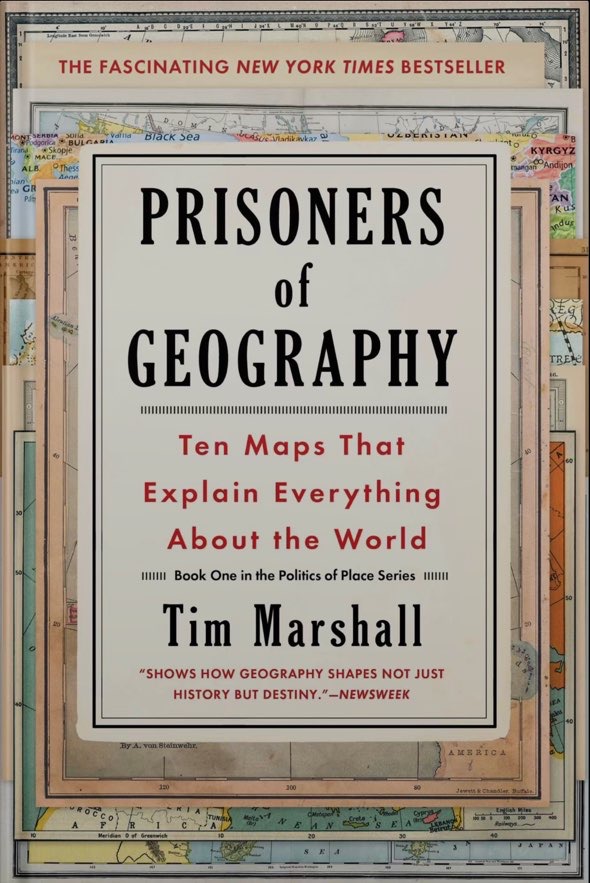
Book Review: Prisoners of Geography
This is an intriguing book and a must read for anybody who is remotely interested in geopolitics. The author basically talks about how geography has driven the security or lack thereof of all countries. In spite of technology today, high mountains, deep seas and wide rivers drive most of the geopolitical calculations of every country. This stems from the need to protect trade and security of its citizens.
The book caught my attention right in the first chapter. Very well timed. This was written way before the Ukraine war. But once you read this chapter you will realize why Russia attacked Ukraine. In fact, the author predicted that it waas inevitable. While the author does not condone war – and like all of us – is numbed at the deaths and atrocities, he points out the history of the Northern European Plains – thru which over centuries many many countries have attacked Russia. In fact about once in every 35 years!
Some of the fascinating facts you will learn will include why Europe has so many countries. Part of the reason lies in geography. Most of the major rivers in Europe do not meet. This formed early boundaries for individual spheres of influence – often giving rise to a cities on the banks where people gathered for trade. Eventually, they became the capitals.
Also how Africa’s tardiness in progress can be traced back to lacking any deep, natural harbors (but beautiful, beautiful beaches) and all those impressive rivers having waterfalls ever so often. Ruling out any convenient modes of trade or transportation.
He continues to give a great narrative of how China’s actions – trade wise and military wise, the India-Pakistan conflict (which he predicts will never end), Korea and Japan, The Middle East – so much of the countries’ political decisions and policies are dictated by simple geography. Once you understand the geography of their borders, a lot of their actions are understandable (may not be condonable).
The other thing the author points out is the lasting negative effects European colonialism has had as they – and this includes the Belgians, French, Spanish, Dutch, Portuguese and worst of all, the British – who arbitrarily drew country boundaries when the left (have you noticed all the straight line boundaries of countries in Africa or the Middle East?) that paid no heed to the kinds of peoples who live there and thereby ensured that geopolitical conflicts will be a permanent thing.
The most fascinating part is the last chapter. He describes how the melting of the Arctic cap will open up more trading lines, bringing down the importance of the Panama canal and the Suez canal and how different countries will have aggressive postures to establish their primacy in the Arctic. This includes countries like Russia, the Scandinavian countries, US, Canada and such.
Again, an outstanding read. Two thumbs up.
1 May
2022
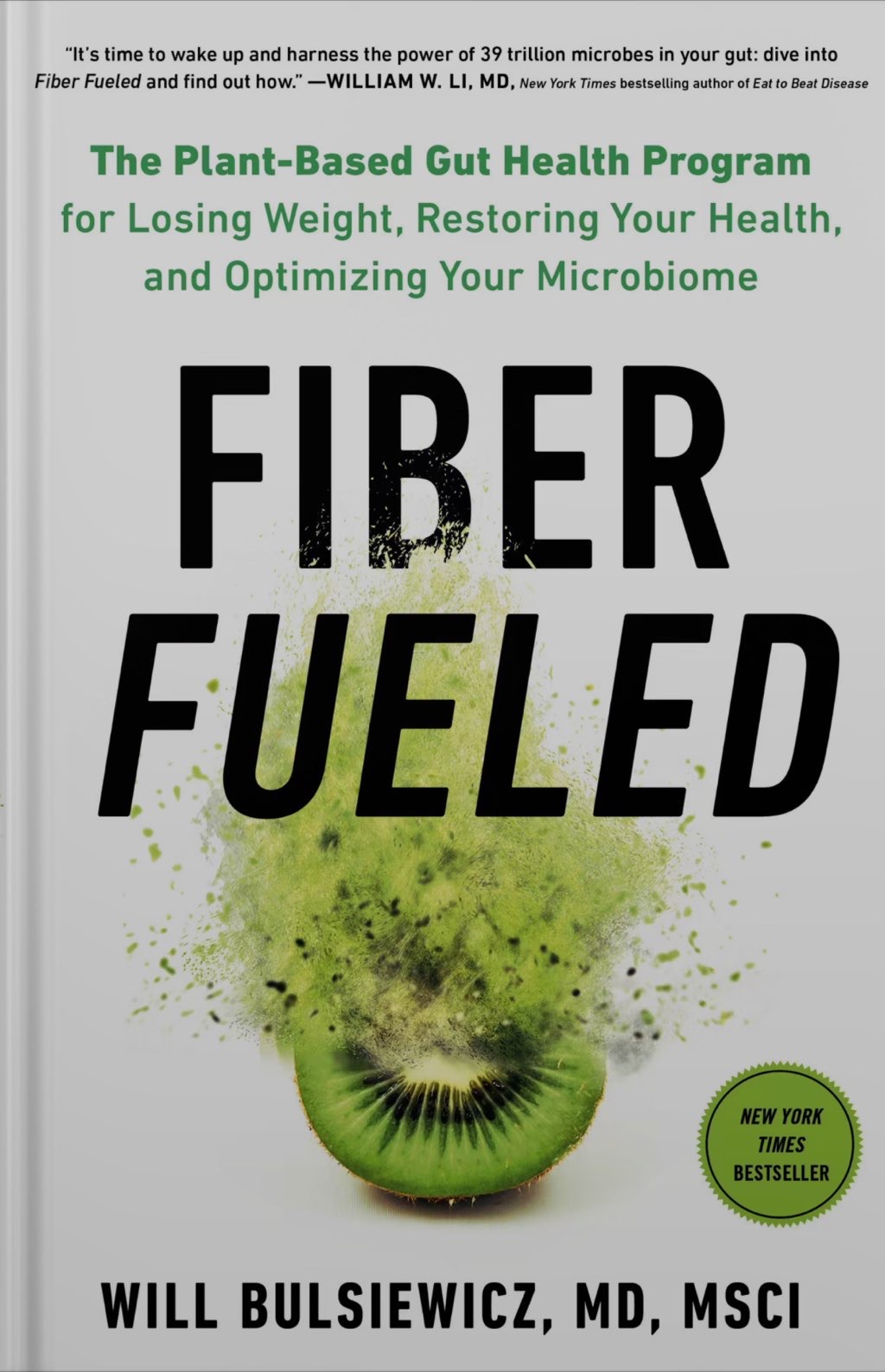
Book Review: Fiber Fueled
I am getting more and more convinced that books written by medical doctors have basically one message – “Here is the one thing – and it will solve all problems of your body”. This book – referred to me by my dietitian – left a similar aftertaste as after reading the book “Why Zebras do not get Ulcers” (remember?). At least that book had a lot of humor and kept the delivery interesting while almost trying to prove that glucocorticoids were the solution to all your problems.
This book was initially interesting to read – it does a great job in explaining the microbiome and how the bacteria works and also how fiber rich foods are processed by our body. But then as you proceed thru the chapters, the author’s pitch become more and more shrill and the writing becomes almost a marketing pitch. Apparently, fiber will solve all our problems. In his defense, he does concede that there are circumstances like celiac disease patients for whom all fiber may not be a panacea.
The challenge for me, of course, is to accept that there is one solution for everybody. Given our bodies are so different from each other – and there are seven and a half billion of them – I would have expected a little more circumspect approach for any truly research based opinion.
Some of the concepts in the beginning are compelling and educational. For example, the way he explains how food choices affect the biome. And how leaky gut causes inflammation. He also teaches the concept of prebiotics, probiotics and postbiotics very well.
Some of his ideas will cause you to sit up. For example, his belief that outside of the five vitals – temperature, pulse, respiratory rate, blood pressure and oxygen level, there should be a sixth one – quality of bowel movement. He does go on to make a compelling case for this.
But then he goes on screaming from the rooftop how every disease can be solved by eating fiber. Often quotes research but I am very skeptical of statements like “Research has shown…”. Not all research are done with the same level of integrity.
In the end, he dedicates another large portion of the book to be a chef with pages and pages of recipes.
That said, I learnt a few things:
1. There are 5 types of microorganisms in our body – bacteria, yeast, parasites, viruses and archaea (never heard of the last one!!)
2. We carry 39 trillion microorganisms in our body. Most of them are bacteria.
3. 90% of serotonin and 50% of dopamine is produced in the gut. This shocked me. I guess that is why the gut is the second brain.
4. Apparently, genetics have less to do with diseases (only 20% – based on studies of identical twins). 99% of our DNA comes from the biome and only 1% is from the rest of our body.
But above all, his concept of “Eat all the colors of plant based food” is sound advice and I would not take anything away from that.
If you read this book, I would suggest start tapering off around the middle of the book.