20 March 2022

Puzzle #2 (logic) from my India trip

This puzzle also comes courtesy my eldest nephew.

There are 101 boxes. A girl marked them “1”, “2”, “3”…. all the way to “101”. She had two colored pens to mark the boxes with – red and blue. And she used both of them. Only one color was used for any one box. We know that the total number of blue boxes is the same as the highest numbered blue color marked box. And to that if you add twice the lowest numbered red color marked box, you will get the total number of boxes.

The question is, how many blue and red boxes were there?

17 March 2022

Puzzle #1 (math) from my India trip

This was given to me by my elder nephew. I was able to solve it but in the process I learnt a new concept in numbers called partition number. My nephew taught me a method of how to get to the partition number for a number. He claimed it is called the Chinese method.

Here is the puzzle:

In the following expression, once expanded, what is the coefficient of x9 ?

(1+x)(1+x2)(1+x3)(1+x4)(1+x5)….(1+x100)

Category: Puzzles | LEAVE A COMMENT
26 February 2022

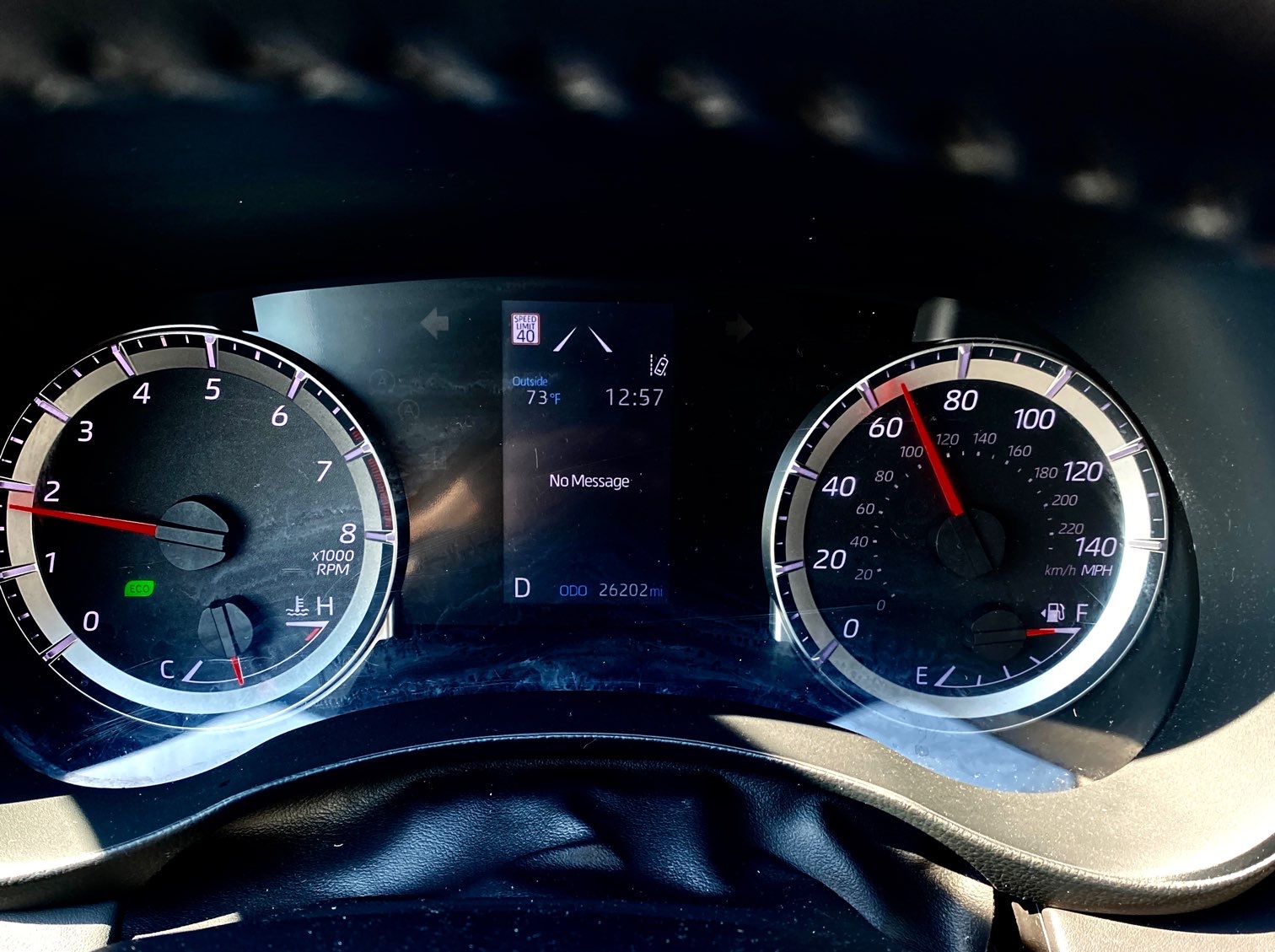
What do you think is happening here?

If anybody is not familiar with interstate highway I-16 in Georgia, it connects Savannah to Macon and pretty much goes like a straight line east-west. There are virtually no towns or cities in between. As a result the 120 mile or so highway has a consistent speed limit of 70 mph.

Sharmila and I were coming back from Hilton Head on this highway. Somewhere in that highway, I noticed something interesting. The display on the rental car dashboard informed me that the speed limit was 40 mph. (see the top middle portion of the picture) I was not in a construction zone and the highway was totally clear.

It took me some time and experimentation to understand what was going on.

Can you guess why the car was giving me completely wrong info (suggesting 40mph in a clearly 70mph stretch)?

If you want a slight hint, check out the other displays on the dashboard in the picture.

27 January 2022

Here is another problem to be solved

Now that we have solved the temperature problem in Chicago, here is another one from San Francisco.

[Errata: Looks like I have completely forgotten my physics – Sound is longitudinal and light is transversal – it is about which way the wave is moving and the particles in the wave are moving.

However, my original question remains – although I cannot remember the terms now – a ray of light goes straight but sound disperses in all directions – like the pool analogy. So, how does this work?]

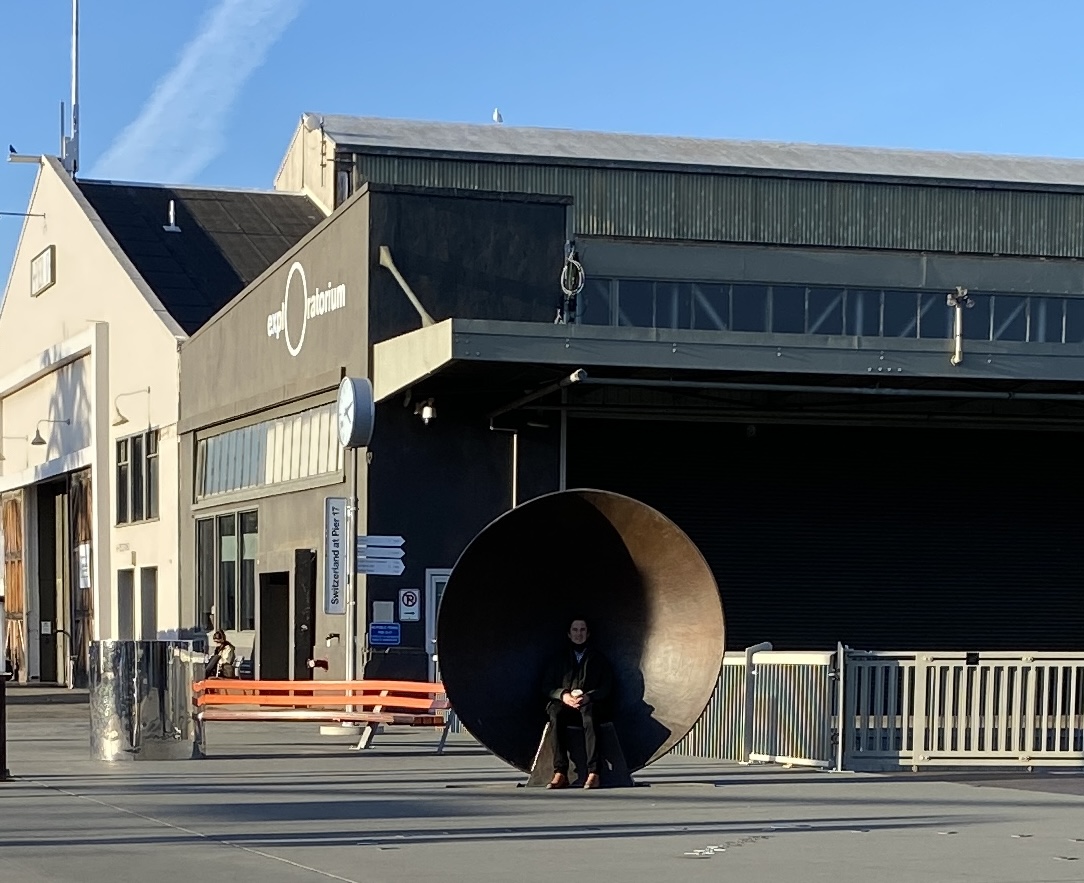
Last week, I was in San Francisco and as his is wont, Matt Moore invited me to go for a walk with him by the waterfront and discuss business issues. While walking around Pier 15 enjoying some nice coffee, he showed me something. It is basically a set of two parabolic metals facing each other about 50 yards away. Each has a small stool to sit on. Matt asked me to go sit on one and he sat on another. As you can see in the picture.

Some of you might have guessed this, I could distinctly and loudly hear what he was saying. It felt like he was just six inches behind my head and he was talking to me from there with a slightly louder than usual voice of his.

For the next few minutes, I showed off my Physics to Matt by eloquently explaining how we were sitting in the focal points of the parabolas and how his voice was hitting his parabola, going then in a straight line to my parabola (geometric property of parabola if you remember) and then my parabola was putting all that on to its focal point which is where I was sitting. You would have seen the same in microwave towers, large telescopes etc. I do not know what Matt thought but I thought I did a good job.

Two days later, I realized what an idiot I was. I was telling Sharmila about it and then half way thru, I stopped cold. I realized that everything I said to Matt was correct but only for longitudinal waves – you know like microwaves, light etc. But sound is a transversal wave. It spreads out in concentric circles (like if you throw a stone in still pool). Those sound waves from Matt would have emanated as concentric circles and then after some of them hit the metal parabola, they would start out as more concentric circles from the point of incidence (where it hit the metal). Then where is the question of focus and all that in an ellipse?

But I experienced it myself.

How do you explain that?
26 January 2022

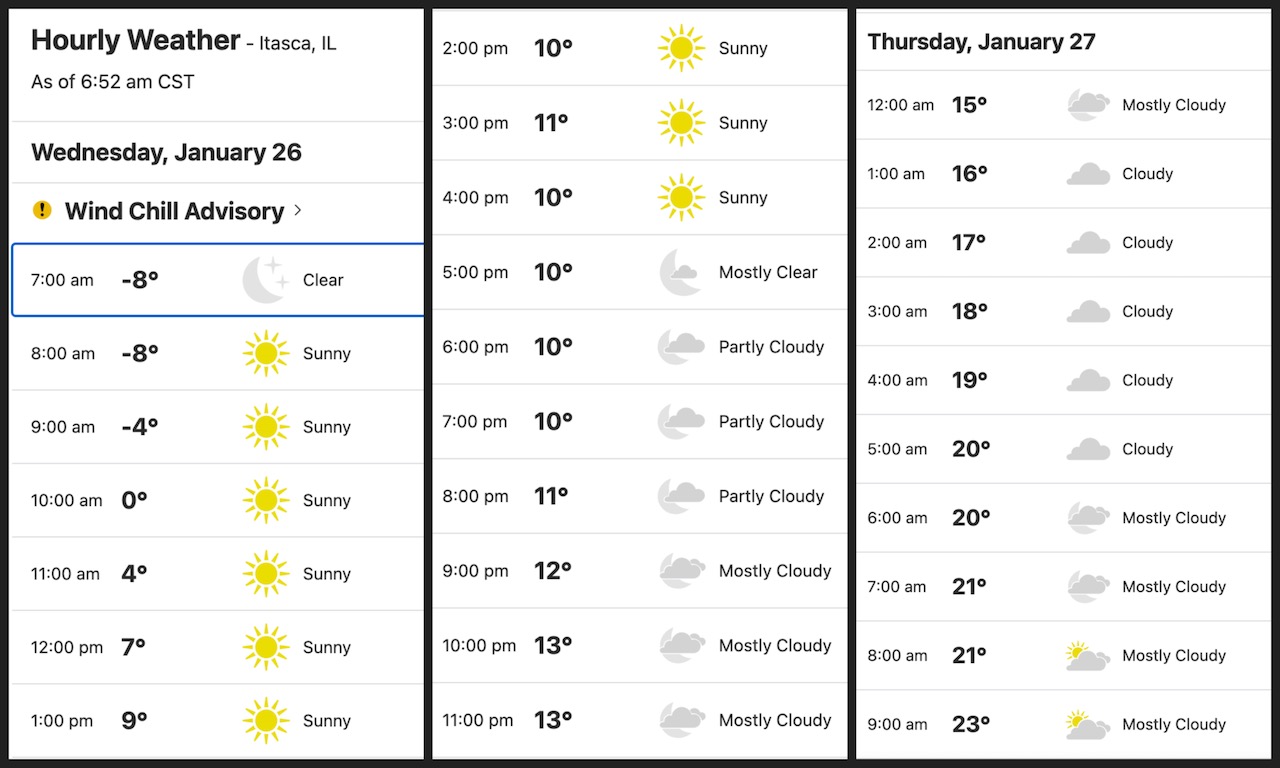
How do you explain this?

It is bone chilling -8F (-22C) right now here in Itasca. But it will slowly warm up as the sun comes up. That part I get. But look what happens after the sun sets. The temperatures keep rising thru the night. Of course, there is no sun around. Lake Michigan water cannot be that warm – after the last few cold days – to explain that.

How do you explain that?

23 January 2022

Football score puzzle

In American football, any drive can end with the following points – 0 (ball turned over), 2 (safety), 3 (field goal), 6 (touchdown with failed point after or failed two pointer), 7 (touchdown and successful point after) or 8 (touchdown and successful 2 point conversion).

Assuming no team scores more than 50 points in a playoff match (there has to be a winner), what are the different legitimate combinations of scores that a match can possibly end with? (e.g. a game can end 14-2 but can never have a 27-1 score).

19 April 2021

Answer to the marbles in Brownian motion puzzle…

The easiest way to think about this problem is not to think of number of marbles in each color but the differences in number between colors. Let’s say “a”, “b” and “c” are the pairwise differences in colors. Their values are 10, 10 and 20 to begin with.

Let’s see what happens whenever there is a “hit”.
If the marbles are of same colors, of course no change in count happens – so a, b and c remain the same.
If the marbles are of different colors – then those two colors go down by 1 each and the third color goes up by 2. Which means the pairwise differences either remain the same (the two colors that hit) or they change by 3 (one color goes down by 1 and the resulting color goes up by 2).

So, the first concept to realize is that a, b and c always change in steps of 0 or steps of 3. There are no other step changes they can have.

Now, let’s say what if the marbles actually did become all of one color. What as the step right before it? We would have had to have all marbles of the same final color excepting two – one each of the other two colors. Thus if finally everything is green, in the penultimate step, there has to be one red, one blue and rest green. The red hits the blue to become green.

Note that in that penultimate step, the pairwise difference between two colors (that have one marble left each) is 0. And that is the second concept to realize.

Now putting these two concepts together…

Well, we started with a, b and c being 10, 10 and 20. Going in steps of 0 and 3, can any of these numbers ever get to 0? No. Therefore it will never reach the penultimate step.

Which means the marbles will never be of the same color !!

Category: Puzzles | LEAVE A COMMENT
16 April 2021

Puzzle to get the weekend started

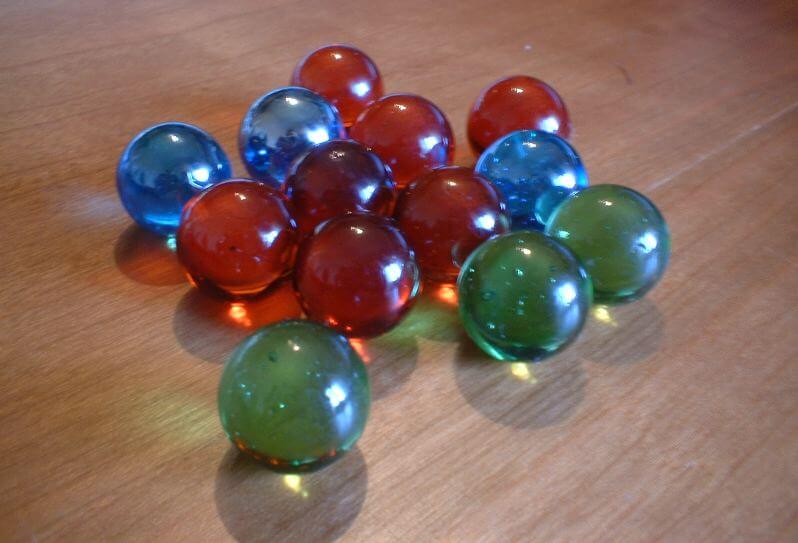
There is a large tray with red, blue and green marbles in it. In fact, there are 20 red marbles, 30 blue marbles and 40 green marbles. In that tray, the marbles are continuously moving around in Brownian (random) motion – often hitting each other.

If two marbles of same color hit each other, they just bounce off and continue. However, if two marbles of different color hit each other, then, both change to the third color and then bounce off and continue. All such hits are always between two marbles only. (no simultaneous three or more marbles hitting each other).

So a red and blue marble hitting each other will make both of them turn green and so on….

Is it ever possible for all the marbles in the tray to become of one color? If so, which color will it be?

Category: Puzzles | LEAVE A COMMENT
30 January 2021

Puzzle: Want to feel better after a Covid test?

This math puzzle about Covid will make your jaw drop (also make you feel better after getting a test)

First, please take all precautions again Covid. If you think you got exposed or have symptoms, get yourselves tested, quarantined and everything else CDC is asking us to do. Once you have done so, think about this puzzle…

The following puzzle – which is a very real one in Covid days – is an adaptation from a puzzle I had posted last year.
The end question I am going to ask you is this:
Q1. Your Covid test came positive. What is the probability that you really have the infection?
Q2. Your Covid test came negative. What is the probability that you really do not have the infection?

As Narayan had pointed out last year, most doctors do not get this. The fact that all tests have false positives and false negatives (they are not perfect) makes the real probability unintuitively high or low.

The real answers will knock your socks off.

Ok, let’s start this:
——
1. The COVID PCR test has a false positive of about 0.5% (*See Source). Which would mean in about 200 people without the virus, the test will make a mistake in one case and say he/she has the virus.

2. The test has a false negative of 10% (** See Source) This means of 10 people who actually have the virus, the test will miss out 1 of them.

3. Assume 2% of Americans at any point of time has the virus (*** See Source)

You went to get a PCR test done. Test showed positive. What is the real probability you have the virus? Hint: It is NOT 99.5%
Take the other case – the test showed negative. What is the real probability you do not have the virus? Hint: It is NOT 90%

Both the answers will make you feel much better.

That should be good enough reason why we should LOVE math! And at the risk of Tammi – the math teacher in my friend circle – slapping my wrist, I would say, you will love the chapter on Conditional Probability.
——

Sources:
* (in reality 0.2%-0.9% per https://www.icd10monitor.com/false-positives-in-pcr-tests…)
** the actual number can widely vary – as high as 67% – depending on when you got tested after exposure. The more time you give after exposure, the more the virus gets to establish itself and lesser the false negative number. https://www.acc.org/…/variation-in-false-negative-rate…
*** I took CDC’s 25% estimated US population had it https://www.cdc.gov/…/2019-ncov/cases-updates/burden.html over 11 months and took the average as 2%. (It will be slightly higher due to ramp ups)