3 November 2019

A hard puzzle from India!

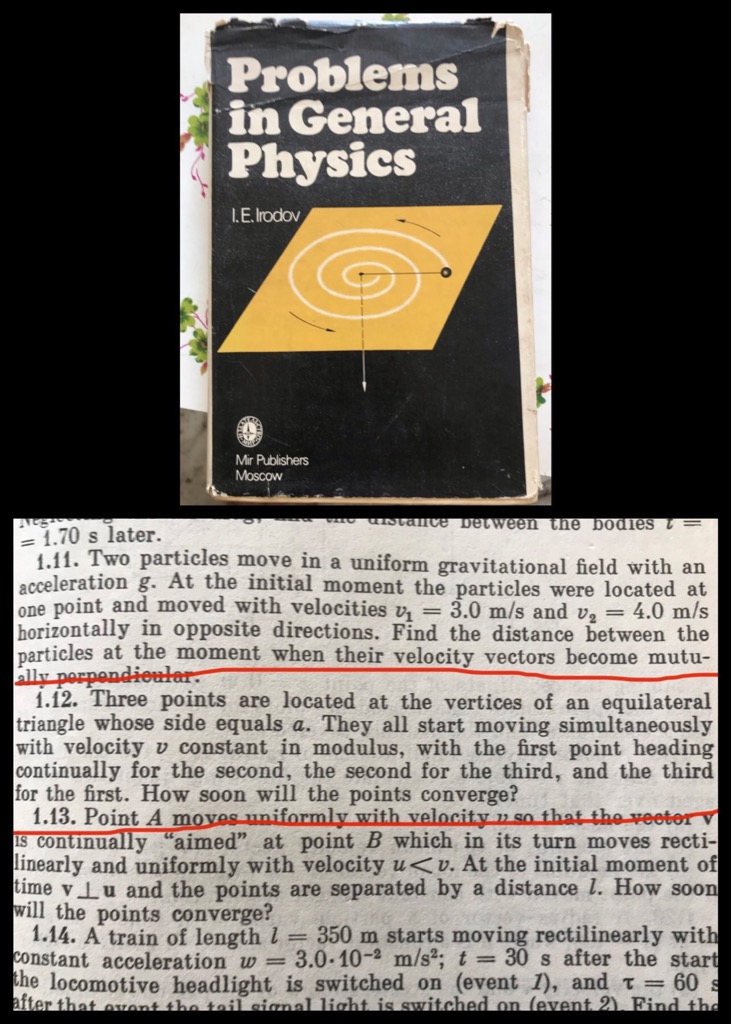
Tuesday afternoon, I was all by myself. Both dad and mom were sleeping. Not knowing anything better, I went around going thru the books that still adorn the book shelves in my parents’ house. These are books from my school days. They have kept them still. Most of them are disintegrating – but they are still there. After going thru some of the books that I had studied in high school, I chanced upon this book I still remember for very hard math/physics problems. Written by Irodov, it was a book I had bought from Kolkata Book Fair in 1984.

I glanced thru a few pages. Sure enough, they are as hard as I remember them. There was one that caught my attention as a very interesting one. You can see the one in the picture that I have circled with the red line.

This is a very tough problem until you hit the solution and realize how elegant the solution is.

Here is a version of the problem:

There is an equilateral triangle – each of side length “a”. There are three ants at the three corners. Let’s call the ants A,B and C. At the same moment the three ants start moving at exactly the same speed. Ant A keeps moving towards wherever Ant B is. Ant B keeps moving towards wherever Ant C is. And Ant C keeping moving towards wherever Ant A is. The question is : eventually when they meet, how much distance would each ant have traveled?

Now realize that for every ant, the target ant is moving continuously. So, every ant is continually changing its direction. It is not as simple as an ant goes from one vertex to the other. That is what makes the problem hard.

After thinking about the problem for some time – and not getting anywhere – I posed it to my brother when I met him two days later. Together we spent about an hour in our drive to Kalyani from Kolkata discussing the problem. Eventually, we reached Kalyani and asked mom for some paper and pen. Another half an hour later, we did manage to solve the problem. Excitedly, we pulled out the Irodov book again from the shelf to see if the answer it had given matched ours. It did!!!

This was only Chapter 1 of the book and the 12th problem in it!! That chapter alone had another hundred plus problems. And then there were many more chapters!!

Man, I am way past my prime when it comes to ability to solve these kind of problems.

Anyways, see if this excites you to give it a crack.

If you get it, try the same problem with a square of side “a” instead of an equilateral triangle.
26 October 2019

Saturday morning puzzle

You might have heard various variations of this problem before.

You have 2 ostrich eggs in your hand (fairly hard shells) and you are in front of a 50 story building. The basic challenge is to figure out which is the floor from and above which the eggs will break on impact to the ground when you drop them from a window of that floor. Of course, this can be done with only one egg. You start with first floor – if it does not break, go to second floor. And keep doing this till you find the floor where it does break. The minimum number of tries you will need to guarantee finding out that floor is 50. (Basically, in the worst case, you have to keep trying all the way to the top)

But you have 2 eggs. Now, the challenge is to find out the minimum number of tries with which you can guarantee finding out that threshold floor at or above which an egg will break (one try means one dropping of an egg). Needless to say, once an egg breaks, you cannot use it again.

19 October 2019

A puzzle for the weekend

In a remote part of an African jungle once lived a bunch of lions. No other animal ever came there. Except one day, somehow a deer showed up. Of course, the lions immediately wanted to eat it. Now, these lions were very smart and very courteous. Some might even say they took special “pride” in it 🙂

Puns aside, here are the rules of the puzzle:
(*) the lions have an understanding that only one lion – whoever is first to touch – can kill and eat a deer. (when one attacks, nobody else does; that is where the courteous bit comes in)
(*) they also know that this deer has a property that whichever lion attacks and eats it, itself becomes a deer the next day (which can be attacked and killed by other lions then)
(*) Every lion is desperate to eat a deer. They are okay to live the rest of their life as a deer itself – but will not do so if they know they might get killed the next day by the lions.

Question: Will the deer survive?

7 October 2019

A quick puzzle

Two students independently come to the library every day after dinner between 7pm and 9pm. Each stays for exactly one hour and then leaves. At any night, what is the probability that they met? (meaning that both were in the library at the same time even if for a very short while)

29 September 2019

Basketball throws: a rather intriguing puzzle

I had run into this problem long time back. I ran into it again last week. Thought will post it. See if you can solve it without using Google to find the answer. If not, then Google it – pretty interesting, huh? (I will post the answer later).

A basketball player keeps track of his throws for a full calendar year. He, of course, misses a few shots and succeeds with a few more. He missed the very first shot of the year. But he ended the year with 83% successful shots. You have to prove that there had to be a point where is success rate was exactly 75%.

Hint: this is not necessarily true for any number – e.g. 60%. But it is always true for 75%.

In fact, can you guess what are the other % (other than 75%) for which this is also true?

3 July 2019

Puzzle time!

Here is one that will have you think about shapes…

Tomorrow is 4th of July and we will be seeing a lot of flags flying proudly all over the USA. Did you know that there is only one country in the world whose flag is not rectangular in shape?

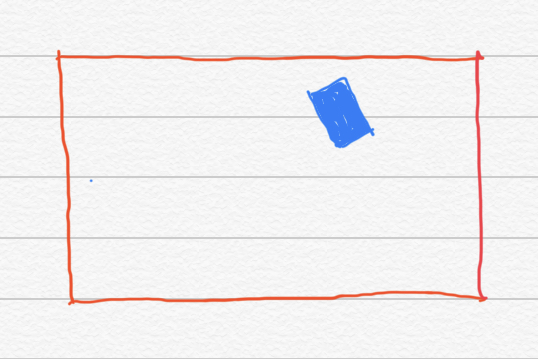
In any case, imagine a country that has a rectangular flag (See my poor rendering in red) with a smaller rectangle of different color inside it somewhere. (See my blue rectangle). Note that the blue rectangle can be anywhere and in any orientation.

Question is, can you cut the flag to make two identical pieces?

4 June 2019

Take a guess…

How many of these statements are true?

1. You can see the Great Wall of China from the moon on clear days (my sixth grade teacher had taught us this)
2. Bulls get excited by red color (which explains why they charge the matador waving the red flag)
3. Napolean was rather diminutive (by French standards those days anyways)
4. Only the royals among the Vikings wore the horned helmets
5. Einstein was weak in math (and failed once) as a school kid.
6. We have 5 senses (sight, sound, taste, touch and smell). (I was taught this pretty early in life).
7. Speaking of senses, the tongue has different parts where we taste different tastes (sweet, salt etc etc)
8. Continuing with our body, artistic folks are more active on the right side of the brain and vice versa for the science and math oriented ones.
9. There is no such thing as a “scientific proof”
10. A steep learning curve implies you will have great difficulty learning it.

If you have Googled, which ones surprised you?

12 May 2019

Sunday morning puzzle

Here is a puzzle we were solving this morning.

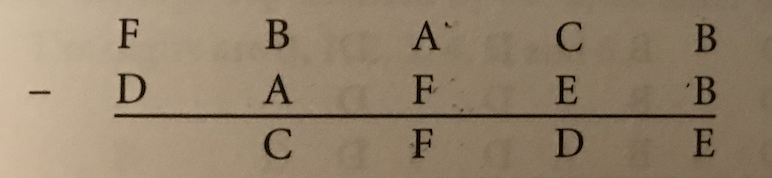
Each letter stands for a digit. Those digits are 0,1,2,3,4,5

One twist – The letters below the line do NOT match the letters above the line in terms of the digits they represent. In fact, the digit represented by a letter above the line is separated from the digit represented by the same letter below the line by 1. So if C below the line is 2, then C above the line has to be either 1 or 3.

Can you solve the following subtraction? Send me a message with the answer.

24 April 2019

Want to try a new puzzle?

Do you know the game Concerto? I did not. Just learnt about it today. The game goes roughly this way –
You start with a grid of squares – can be as big as you want it to be.

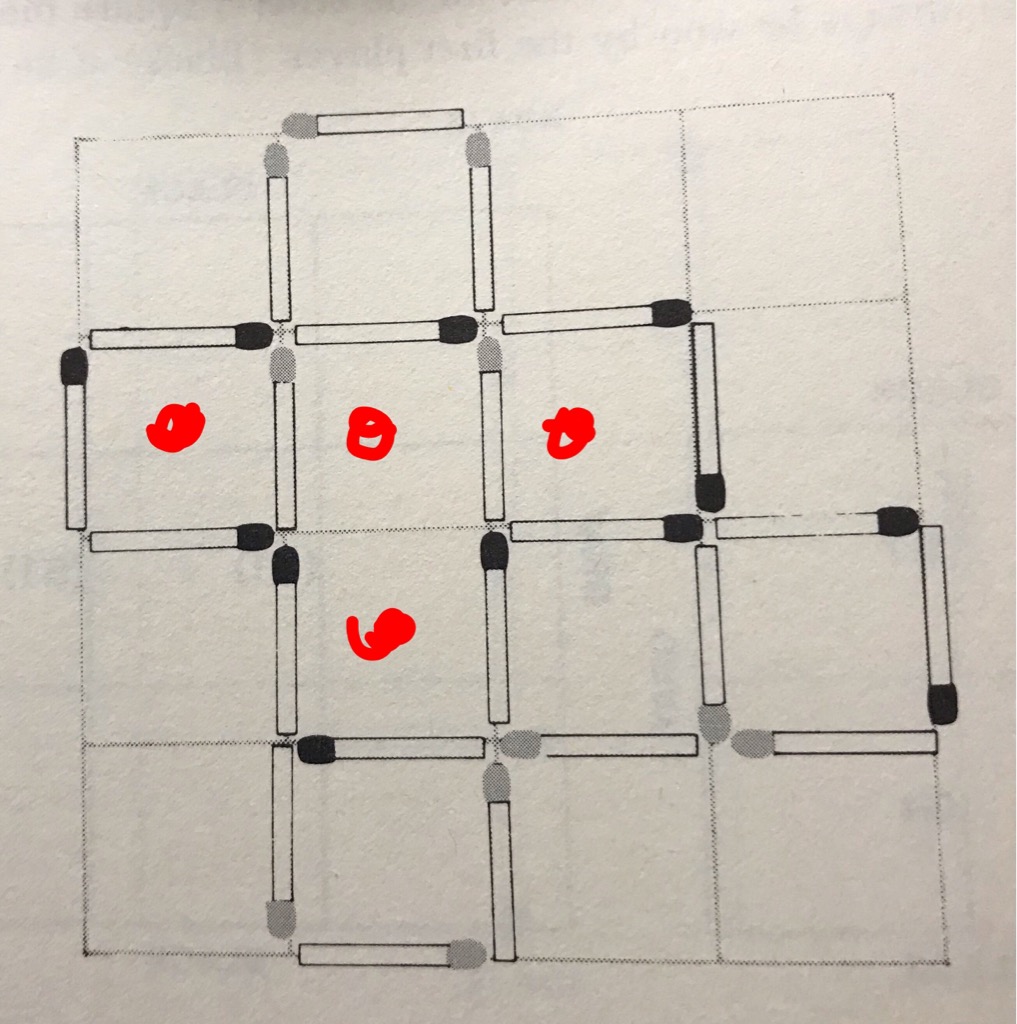
Now two players take turns to draw lines. Each turn can draw a line on any of the sides of any of the grid squares – provided somebody had not drawn there already – and it can be of the length of one side at a time only.
(You might remember a variation of this game where anytime somebody completes a grid square, he/she claims that square and in the end you count up who got how many).

However, in this game, anybody who completes a shape – any shape – entirely by his/her own lines only – wins. Note that it does not have to be a square or rectangle – it can be any shape. Also there might be lines drawn inside the shape by any of the players – it does not matter. It just needs to be a completed shape with one player’s lines only.

Look at the picture below as an illustration. The player with lines with black tips wins. Think of the shape comprising the four squares marked with red blobs – that is a complete shape built by the black tip lines only.

Here is the question. Just like the second player in a game of tic tac toe can always prevent the first player from winning, in this game too, the second player can come up with a strategy that will ensure that the first player can never win regardless of how big the grid is.

Can you come up with such a strategy?

(Send me PM with your answers; I will publish your correct answers in the Comments section later)

Category: Puzzles | LEAVE A COMMENT
24 March 2019

What am I doing wrong with this puzzle?

Remember the puzzle I posted last Saturday? https://www.rajibroy.com/?p=18817 The real problem in the book “The Riddler” (thank you Matt Moore for giving me that book) had 7 in the team – not 3. And the answer the book has 7/8. I am getting a far better probability. What am I doing wrong?

The problem, to remind ourselves is – randomly a black or white hat will be put on each of 7 of us. We cannot see our own color but we can see everybody else’s color. When called upon to guess our own color, we can call Black or White or we can say Pass. If one calls Black or White and is right, then the whole team wins. If it is wrong, then the whole team loses. However, if Pass is called, another person in random is asked to guess the color on their head. If everybody Passes then the whole team loses. What is the strategy to maximize the chance to win and what is that probability?

I am attaching the answer in the book which comes to 7/8 (using XOR logic).

My answer is the following:
The first person : If he sees the same color on the other six, he randomly calls a number. Else he says Pass.

The second person : Now he gets a chance only if the first person called Pass. Which means the first person has effectively said “All of you DO NOT have the same color”. So, if the second person sees the same color on everyone of the rest five, he simply calls the opposite color. He is guaranteed to be right. If he sees NOT all hats with the rest five to be of the same color, he simply says “Pass”.

The third person : uses the same logic. If the rest four have the same color, simply call the opposite color. Else say Pass.

This will go recursively and somebody is guaranteed to get the right answer. (In the absolute extreme case, The fifth person will call Pass – which is telling the sixth and seventh person – “Hey you two have different colors” and the sixth person can see the seventh person’s hat color….)

So independent of how many original players were there, there are only 2 cases the team loses – when the first person saw everybody else having the same color (all white or all black) and his random guess of his own color turned out to be wrong.

So, they lose with a probability of 2 / (2 the power n)

Winning probability is (1 minus the above) – which is much higher than 7/8

What am I doing wrong?