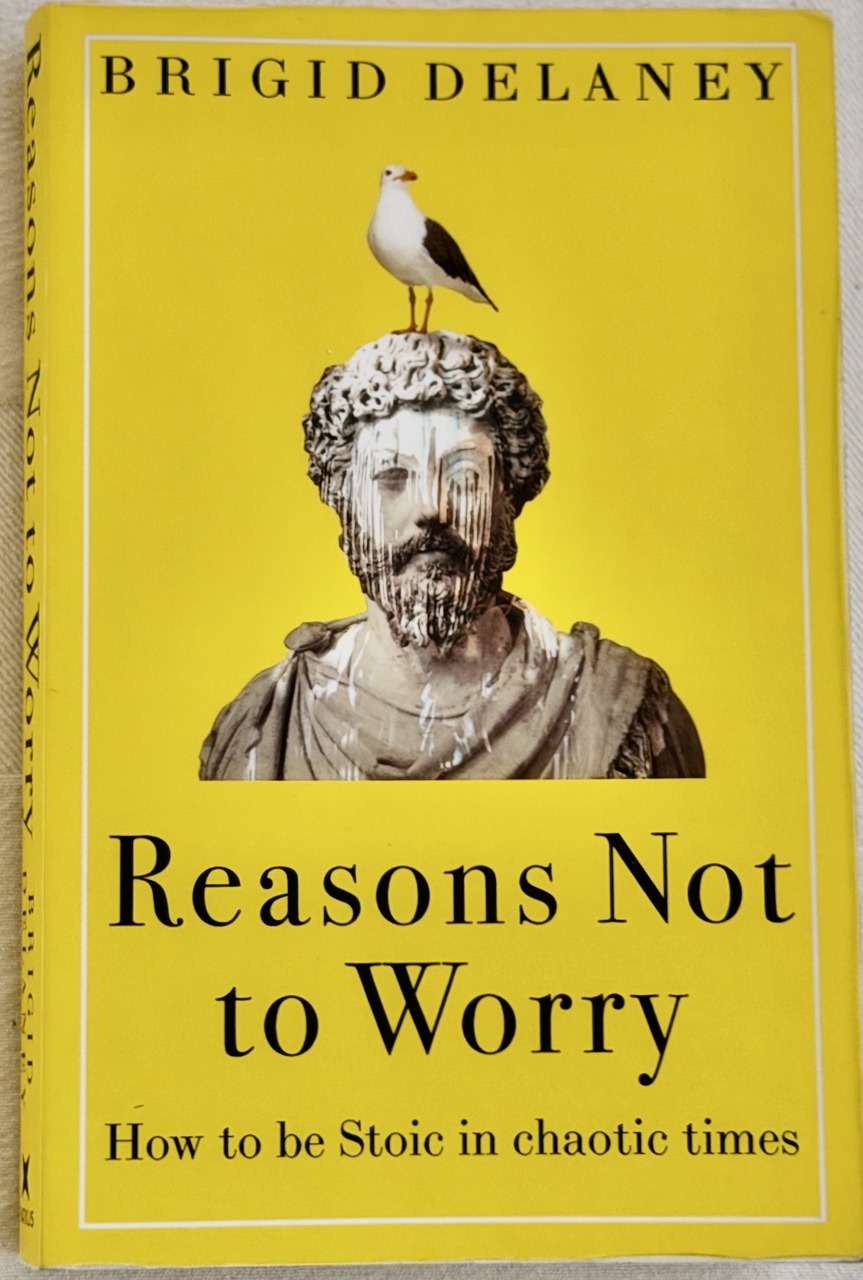
Book Review: Reasons Not to Worry by Brigid Delaney
How to be Stoic in chaotic times
I picked up this book at a bookstore in Luxembourg last month.
The book’s core theme is to familiarize readers with the principles of Stoicism. The author – a journalist from Australia – narrates various moments of her life and draws parallels to how a Stoic would have responded differently or how following Stoic principles changed her own responses.
If you are familiar with Stoic philosophy, this could be a good refresher. One thing the author does is quote profusely from philosophers like Cato, Seneca, Epictetus, Marcus Aurelius, and the like.
A couple of interesting words/phrases I learned are “ataraxia” and “hedonic adaptation”. I knew the concept but not the words.
The author also makes a few of her own observations.
Her fundamental assertion is that we can control our character, our reactions, and how we treat others. Beyond that, attempting to control anything else can only bring unhappiness, frustration, anger, and such.
Another realization she has come to – that got me thinking – “I had begun to become suspicious of the concept of happiness, seeing it as a swing state that, before too long, ushered in its opposite: despair”
She also interprets, in her own way, what she refers to as “Preferred Indifferents”, meaning it’s preferable to have them, but you should essentially be indifferent as to whether you got them or not (e.g., health and wealth), and “Unpreferred indifferents”, meaning those that you don’t really want but generally should be indifferent to (e.g., death, disease, pain, ugliness, poverty, etc)
She stresses the concept of “negative visualization” a lot. Her advice: treat every encounter with everyone, especially people close to us, as if it may be the last. Use negative visualization regularly but fleetingly.
A few killer quotes:
Seneca: “The one who puts the finishing touches on their life each day is never short of time”
St. Augustine: “Resentment is like drinking poison and waiting for the other person to die.”
Marcus Aurelius: “Seek admiration from the people you know. People who seek admiration from those they have never met and never will, they might as well be upset by not being a hero to their great-grandfather.”
Carl Jung: Thinking is difficult. That’s why people judge.
More pearls of wisdom from the philosophers:
Oscar Wilde:
• It takes great courage to see the world in all its tainted glory, and still to love it.
Seneca:
• Whatever can happen at any time can happen today
• Misfortune weighs most heavily on those who expect nothing but good fortune
• Learning how to live takes a whole life, and it takes a whole life to learn how to die.
• We suffer more in imagination than in reality.
• The greatest cure for anger is to wait so that the initial passion it engenders may die down and the fog that shrouds the mind may subside or become less thick.
• The final hour when we cease to exist does not itself bring death. It merely, of itself, completes the death process. We reach death at that moment, but we have been a long time on the way.
Marcus Aurelius:
• Very little is needed to make a happy life. It is all within yourself, in your way of thinking.
• The universe is change. Our life is what our thoughts make it.
• Everything we hear is an opinion, not a fact. Everything we see is a perspective, not the truth.
Epictetus
• I cannot escape death, but at least I can escape the fear of it.
• Time is your most valuable currency.
• The more we value things outside our control, the less control we have.
• It’s not what happens to you, but how you react to it that matters
• “Wealth consists not in having great position, but in having few wants.”